
The ability to synthesize over twenty different complex natural products without human intervention marks a significant shift in the future of laboratory operations. For decades, the pharmaceutical industry has grappled with a frustrating disparity between the speed of computational drug discovery and the physical reality of chemical synthesis. While modern artificial intelligence can design novel molecular structures in a matter of seconds, the actual production of these compounds has remained a labor-intensive endeavor, often requiring months of manual trial and error by chemists. This logistical hurdle has frequently delayed the transition from a digital model to a tangible therapeutic candidate. However, recent breakthroughs in automated chemistry have begun to dismantle these barriers, offering a streamlined pathway from conception to creation. By removing the requirement for human oversight, researchers can now maintain high-throughput operations that function continuously without pause.
Mechanical Bridges for Synthesis
Robotics and Continuous-Flow Systems
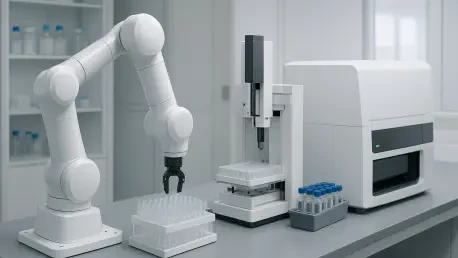
At the heart of this transformation is a sophisticated 24-hour unmanned synthesis platform developed by researchers at the Korea Advanced Institute of Science and Technology. Led by Professor Yoonsu Park, the team successfully integrated several disparate technologies into a singular, cohesive ecosystem capable of executing complex organic reactions. The hardware configuration includes material-preparation robots that precisely weigh and mix reagents, automated pumps for fluid management, and a specialized light-irradiation reaction chamber. This setup utilizes a method known as a continuous-flow process, which departs from the traditional batch-style chemistry that has dominated the field for over a century. In a flow system, chemicals are pushed through narrow tubing, ensuring that every portion of the solution receives identical exposure to light. This uniformity is critical for photochemical reactions, where light penetration is often inconsistent in traditional vessels.
Real-Time Analysis and Feedback
Beyond simple automation, the system incorporates high-precision analytical instruments that monitor the chemical reactions in real-time. Once the robotic components complete a synthesis cycle, the resulting solution is automatically routed to these sensors to verify the purity and yield of the target compound. This closed-loop feedback mechanism ensures that any deviations in the reaction environment are immediately detected, allowing for rapid adjustments without human intervention. The integration of such analytical tools represents a significant leap forward, as it eliminates the need for manual sampling and offline testing, which are common sources of delay. By standardizing the physical parameters of every reaction, the platform provides a level of reproducibility that was previously unattainable in manual lab settings. This technological synergy not only accelerates the pace of research but also enhances safety by minimizing human exposure to various toxic reagents.
Precision at the Atomic Level
Mastering Single-Atom Editing
One of the most remarkable capabilities demonstrated by this autonomous system is its proficiency in single-atom editing, a technique that allows for the surgical replacement of specific atoms within a molecular structure. The KAIST research team focused specifically on furan-based compounds, utilizing the robotic platform to swap out single atoms to create N-methyl pyrrole scaffolds, which serve as foundational building blocks for numerous pharmaceuticals. In traditional research, such precise modifications are incredibly difficult to achieve without inadvertently altering the rest of the molecular backbone. However, the automated system’s ability to precisely control light intensity and reaction timing makes these delicate transformations much more reliable. This level of precision is vital because a change as minor as a single atom can completely transform a drug’s pharmacological profile, influencing how it binds to proteins. This precision allows for exploring a wider chemical space safely.
Accelerating Drug Development
The successful deployment of this unmanned platform established a new paradigm where the physical synthesis of drugs finally matched the velocity of digital innovation. Researchers found that the ability to generate vast libraries of structurally related compounds overnight significantly shortened the timelines for identifying viable clinical candidates. This progress offered a clear blueprint for pharmaceutical companies seeking to integrate automated organic synthesis into their standard research workflows from 2026 to 2030. By quantifying every reaction variable, the system provided a foundational dataset that improved the predictive accuracy of future AI models, creating a virtuous cycle of discovery and production. The transition toward these autonomous environments empowered scientists to focus on high-level strategy rather than the repetitive mechanics of bench chemistry. The technology demonstrated that the marriage of robotics and flow chemistry was the catalyst for a responsive era of global medicine.