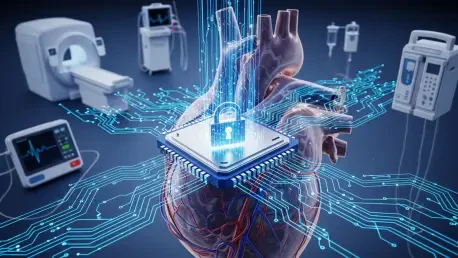

Hospitals now manage more lines of code than surgical instruments, as the Internet of Medical Things (IoMT) transforms sterile environments into highly interconnected data hubs where every heartbeat is a packet of information. This digital metamorphosis has moved clinical operations beyond traditional boundaries, with connected devices and remote monitoring systems now serving as the fundamental backbone of modern care delivery. With the IoMT market currently accelerating toward a valuation of over $800 billion by 2032, the volume of sensitive medical data circulating through healthcare networks is reaching unprecedented levels. This evolution represents more than a mere technological upgrade; it is a fundamental reconfiguration of how patient data is harvested, analyzed, and leveraged for clinical decisions. However, this shift introduces a complex security paradox that providers must navigate with extreme precision. While real-time data facilitates better outcomes, it simultaneously creates a massive, fragmented attack surface where every connected sensor is a potential entry point for malicious actors. Balancing these technological breakthroughs with rigorous digital protection is no longer an IT preference but a core requirement for patient safety.
Leveraging IoT for Enhanced Clinical Care
Worker Safety: Protecting Lone Healthcare Professionals
One of the most vital applications of IoT in healthcare is the protection of “lone workers,” such as community nurses and social workers who often operate in isolation outside traditional hospital walls. These professionals are frequently exposed to physical threats or sudden medical emergencies in remote locations where cellular reception is spotty or traditional communication is insufficient. GPS-enabled wearables and sophisticated geofencing technology have revolutionized their safety protocols by providing automated alerts and real-time location tracking that functions independently of manual input. If a worker fails to check in at a pre-scheduled interval or leaves a designated safe zone during their rounds, supervisors are immediately notified via a centralized dashboard, ensuring a swift response to potential emergencies. This layer of digital oversight does not just protect the employee; it provides the peace of mind necessary for healthcare organizations to expand their reach into underserved areas without compromising the physical security of their field staff. Moreover, the integration of these devices with emergency dispatch systems means that first responders can receive precise coordinates even if the worker is incapacitated, effectively closing the gap between a critical incident and the arrival of professional assistance.
Senior Monitoring: Proactive Fall Detection Systems
In geriatric care, IoT technology has shifted the paradigm from reactive to proactive monitoring through the implementation of automated fall detection systems that utilize artificial intelligence. Traditional emergency systems often required patients to manually press a pendant or button, a requirement that frequently failed if the individual was rendered unconscious, disoriented, or physically unable to reach the device. Modern motion sensors and pressure-sensitive wearables can now detect the unique signatures of a fall automatically and alert caregivers instantly without any patient intervention. By minimizing the “long lie”—the time a patient spends on the floor without assistance—these devices significantly improve clinical outcomes and reduce the likelihood of long-term complications such as dehydration or muscle breakdown. This technology allows elderly patients to maintain their independence for longer periods within their own homes, which is a key goal for modern public health initiatives. Furthermore, these systems can track subtle changes in gait or activity levels over time, providing clinicians with early warning signs of physical decline before an injury occurs, thereby moving the focus of care toward prevention rather than just crisis management.
Navigating the Landscape of Cyber Threats
Data Privacy: Risks to Medical Records and Identity
Despite the clear clinical benefits of a connected ecosystem, the high value of healthcare data on the global black market makes medical networks a primary target for sophisticated cyberattacks. Personal medical records are uniquely valuable because they provide a permanent, immutable history that cannot be changed or reset, unlike a compromised credit card number or a social security digit. This permanence allows criminals to engage in long-term identity theft, insurance fraud, and even extortion based on sensitive health conditions revealed in the stolen data. A single vulnerability in a low-power wearable device or a poorly secured smart monitor can lead to the exposure of thousands of patient records, bypass firewalls, and compromise the integrity of an entire hospital’s database. For smaller healthcare organizations, the resulting regulatory fines and the irreparable reputational damage following such a breach can be financially devastating, often leading to bankruptcy or forced mergers. The challenge is compounded by the fact that many IoT devices were designed for medical functionality first, with cybersecurity protocols often treated as a secondary consideration during the manufacturing process, leaving significant gaps in the digital perimeter.
System Disruptions: Ransomware and Lateral Movement
Beyond the threat of data theft, ransomware poses a direct and immediate risk to patient safety by locking providers out of essential clinical systems during critical hours of operation. When surgical schedules, diagnostic imaging, and electronic health records are encrypted by attackers, hospitals are often forced to cancel life-saving procedures or divert ambulances to other, already overcrowded facilities. This disruption creates a ripple effect throughout the regional healthcare network, delaying care for patients who are in the middle of emergency scenarios where every second matters. Furthermore, many IoT devices are vulnerable to lateral movement, a technique where an attacker accesses a low-security device, such as a smart thermostat or a digital signage board, to pivot toward high-value targets like life-support machinery or infusion pumps. This inherent interconnectivity means that the safety of the entire hospital often rests on the security of its weakest link, as a breach in a non-clinical device can theoretically allow an intruder to manipulate the settings of a device delivering medication to a patient. Consequently, the boundary between digital security and physical patient harm has completely dissolved, making robust cybersecurity a vital component of the Hippocratic Oath.
Strengthening Defensive Frameworks
Implementation Strategies: Bridging the Resource Gap
A significant disparity currently exists in how different healthcare organizations manage these evolving threats, a phenomenon often referred to in the industry as the “vulnerability gap.” While large hospital networks and academic medical centers typically have the budget to maintain dedicated, 24/7 security operations centers, smaller rural practices and specialized clinics frequently operate with limited IT staff and legacy infrastructure that was never intended for the modern threat landscape. This resource gap makes smaller providers particularly attractive targets for cybercriminals, as they offer a path of least resistance into the broader healthcare ecosystem. To address this imbalance, organizations must move toward scalable security models that provide enterprise-level protection without requiring an unmanageable internal capital investment. Cloud-based security platforms and shared threat intelligence networks allow smaller entities to benefit from the same level of protection as their larger counterparts by pooling resources and data. This collective defense strategy ensures that a threat detected at one facility is immediately blocked across all participating organizations, creating a more resilient healthcare infrastructure that protects patients regardless of where they receive their care.
Security Culture: Awareness and Technical Controls
Building a robust defense requires a harmonious combination of technical controls and a pervasive culture of security awareness among the entire clinical and administrative staff. Fundamental practices, such as implementing strict multi-factor authentication for every system access point, using end-to-end encrypted data transmission, and maintaining rigorous, automated software patching schedules, are essential for shrinking the available attack surface. However, technology alone cannot solve the problem, as human error and sophisticated phishing schemes remain the leading causes of initial network breaches in the medical sector. Healthcare workers at every level must be trained to recognize social engineering tactics and understand the critical role they play in protecting patient data. A security-conscious workforce is just as critical to patient safety as any hardware solution or software firewall, as they serve as the final line of defense against an intruder. By integrating cybersecurity training into standard clinical education, organizations have begun to treat digital hygiene with the same level of seriousness as handwashing and sterile techniques, recognizing that a breach in protocol can be just as deadly as a hospital-acquired infection.
Future Resilience: Technology Partnerships and Managed Services
The selection of specialized technology partners and the strategic use of Managed Service Providers (MSPs) acted as a force multiplier for healthcare security throughout recent years. These providers offered continuous, expert-level monitoring and professional-grade incident response capabilities that many clinics simply could not manage or afford internally. By outsourcing the immense complexity of network management and threat hunting to dedicated experts, healthcare providers ensured that their core infrastructure remained resilient against rapidly evolving cyber threats. This shift allowed medical professionals to refocus their energy entirely on clinical outcomes rather than the nuances of firewall configuration or database encryption. Looking ahead, the healthcare sector recognized that protecting the network was an inseparable part of the modern commitment to protecting the patient, leading to the adoption of “security-by-design” principles for all new medical device procurements. Organizations that prioritized these defensive frameworks moved beyond mere compliance, creating an environment where technological innovation and patient safety coexisted without compromise. The integration of advanced encryption and zero-trust architectures ultimately paved the way for a more secure and efficient era of digital medicine.