
The biological sciences currently face a profound technical paradox where researchers can either observe the precise location of a cell or its deep molecular secrets, but rarely both at the same time. For years, the standard approach to single-cell sequencing required the physical destruction of tissue samples, effectively shredding the biological map to read the individual genetic instructions contained within. This fragmentation left a massive void in our understanding because the physical environment, or the neighborhood of a cell, fundamentally dictates its behavior and function. By removing the spatial context, scientists were often left with a list of active genes but no way to know how those genes were interacting with neighboring cells or responding to local environmental cues. The emergence of new spatial transcriptomic techniques has finally started to bridge this gap, allowing for the mapping of full-length RNA isoforms directly within intact tissue structures. This breakthrough provides a more holistic view of cellular activity, ensuring that the critical relationship between location and molecular identity remains preserved.
Bridging Spatial Context and Molecular Completeness
Technical Integration: Stereo-seq Meets Long-Read Sequencing
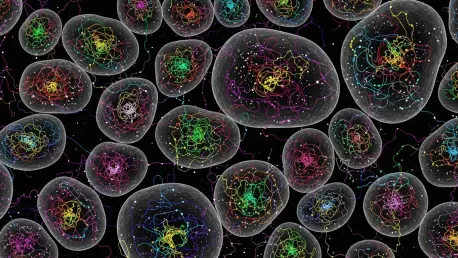
At the heart of this advancement is the sophisticated integration of Stereo-seq and long-read sequencing technologies, which work in tandem to capture genetic information across large tissue samples at an incredibly high resolution. Stereo-seq utilizes specialized DNA nanoball arrays that provide a grid-like framework for capturing transcripts without losing their original coordinates. While older methodologies were primarily limited to identifying small fragments of RNA—often only the ends of a molecule—this modern approach sequences the entire RNA strand from start to finish. By merging these two distinct tools, researchers can now see exactly which full-length transcript is active and pinpoint its precise location within the complex tissue architecture. This high-definition mapping allows for a level of clarity that was previously unattainable, as it combines the breadth of whole-tissue imaging with the depth of single-molecule sequencing, creating a comprehensive atlas of gene expression that includes every detail of the transcript structure.
Molecular Nuance: Addressing the Complexity of RNA Splicing
This level of structural detail is critical because of the biological phenomenon known as alternative splicing, where a single gene can produce multiple different versions of messenger RNA, commonly referred to as isoforms. These variations are not mere redundancies; they can have drastically different functional effects, where one version might promote cellular survival while another variant of the same gene could trigger programmed cell death. Traditional spatial tools often lack the resolution to distinguish between these variants, grouping them together and inadvertently masking the true molecular complexity of the tissue. Fullscope-seq effectively removes this layer of guesswork, allowing scientists to distinguish between helpful and harmful versions of the same gene while maintaining a perfect spatial map. This capability is essential for identifying how different isoforms are distributed across tissue layers, revealing that cellular identity is defined not just by gene expression, but by the specific version of the transcript produced in a given location.
Practical Applications in Neuroscience and Medicine
Neural Mapping: Understanding Primate Brain Architecture
Researchers recently demonstrated the effectiveness of this method by studying the macaque brain, which represents one of the most complex biological environments known to modern science. By applying this technology to primate brain tissue, they were able to identify thousands of transcript isoforms that were previously invisible to standard sequencing techniques. The results of the study revealed that gene expression varies significantly across different layers and regions of the brain, suggesting that the intricate logic of neural function is shaped not just by which genes are turned on, but by which specific isoforms are active in certain cellular neighborhoods. This discovery provides a new lens through which to view neural connectivity and development, as it highlights how the brain uses a diverse library of transcripts to fine-tune its operations. Understanding these subtle differences is key to mapping the functional architecture of the brain, as it allows researchers to see how specific isoforms contribute to the unique roles of different cortical layers.
Precision Medicine: Advancing Targeted Drug Discovery
These findings have major implications for the pharmaceutical industry and the development of next-generation medicines that aim to be more precise and effective. By identifying specific disease-causing isoforms that only appear in damaged or malignant tissue, researchers can now design drugs that are significantly more targeted than current therapies. This specialized approach could drastically reduce side effects by sparing healthy tissue where the same gene might perform a different, necessary function through a separate isoform. Additionally, this technology helps scientists understand why some patients become resistant to treatment, as certain cell populations may be utilizing isoforms that the drug simply cannot recognize or target effectively. As researchers continue to build databases of isoform expression in various disease states, the path toward personalized medicine becomes much clearer. The ability to distinguish between these molecular twins ensures that treatments are tailored to the exact version of the protein causing the pathology, leading to better patient outcomes.
Navigating the Challenges of High-Resolution Data
Data Analysis: Leveraging Artificial Intelligence for Insights
The arrival of this technology signals a necessary transition from descriptive spatial biology to a more mechanistic and functional understanding of biological life. Earlier generations of tools were largely focused on creating static maps of gene expression, but the next wave of innovation is focused on how different molecular layers interact to drive either health or disease. This shift is being supported by massive improvements in computational biology and artificial intelligence, which are essential for processing and interpreting the vast amounts of data generated by sequencing full-length transcripts at such a high resolution. Analyzing millions of long-read sequences within a spatial context requires robust algorithms that can manage the noise and complexity inherent in such deep datasets. As these computational pipelines become more refined, they will allow researchers to predict how changes in isoform distribution might lead to the onset of specific symptoms, effectively turning big data into actionable clinical insights that can guide future medical interventions.
Clinical Outlook: Transitioning to Mechanistic Patient Care
Despite the immense potential shown during these early implementations, several significant obstacles remained before the technology became a standard fixture in every laboratory. The higher cost and slower processing speeds of long-read sequencing compared to traditional methods initially limited the scale at which massive population-wide studies could be conducted. However, the move toward affordability and efficiency accelerated as the benefits for human diseases like cancer and neurodegeneration became undeniable. Researchers focused on streamlining the library preparation process, which helped to democratize access to high-resolution spatial data for smaller research institutions. By integrating these advanced workflows into clinical diagnostics, the medical community established a new baseline for precision oncology and neurology. These efforts ensured that the ability to see the whole truth of RNA expression became a cornerstone of modern medicine. This evolution in spatial biology provided the necessary tools to finally decode the most complex aspects of human health through the lens of isoform diversity.