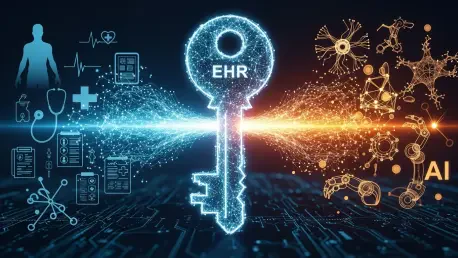

Health systems today are drowning in a sea of promise as thousands of hospitals invest billions into artificial intelligence, yet recent industry audits reveal that over sixty percent of these clinical deployments fail to provide a measurable return on investment within the first eighteen months. This staggering failure rate stems from a fundamental disconnect between high-level algorithmic capability and the practical, day-to-day realities of hospital operations. While administrators frequently purchase cutting-edge tools to address acute staff shortages and physician burnout, many of these solutions arrive as standalone applications that lack a bridge to the primary digital infrastructure. The Electronic Health Record (EHR) remains the undisputed source of truth in any clinical setting, and any tool that does not exist within its ecosystem is destined to become a burden rather than a benefit. Without a seamless, two-way connection, AI tools create more manual labor for clinicians.
The Risks of Disconnected Innovation
The Anatomy of Stalled Pilot Programs: Why Innovation Falters
The phenomenon known as stalled pilot syndrome has become a pervasive challenge for healthcare executives who witness promising technology projects abandoned only a few months after their initial launch. These failures rarely occur due to a lack of computational power or poor user interface design; instead, they are the direct result of data becoming trapped in an isolated silo that clinicians cannot easily access. For instance, if a sophisticated scheduling bot identifies a high-risk patient’s need for an urgent follow-up but cannot view the physician’s real-time availability or book the appointment directly, it transforms from a solution into a logistical liability. Medical staff quickly develop a profound distrust for tools that force them to manually transcribe data from an external AI dashboard back into the primary medical record. This friction not only slows down the pace of care but also introduces significant risks of human error during the transcription process.
Technical Obstacles: Navigating Bidirectional Data Exchange
Bridging the gap between modern artificial intelligence and traditional medical systems is a complex task because most large health networks rely on a patchwork of legacy software platforms. Achieving a true bidirectional sync, where an AI can both read from and write back to the medical record, serves as the ultimate technical benchmark for determining whether a digital tool will succeed or fail. Moving beyond simple data extraction is essential for maintaining high standards of HIPAA compliance and security, as it ensures that the patient record remains the single, accurate point of reference for the entire care team. When an AI tool lacks the permissions or the technical framework to update the EHR in real time, it creates a fragmented environment where duplicate entries and outdated information become common occurrences. This synchronization is not merely a technical preference; it is a clinical necessity that allows algorithms to function as reliable assistants rather than as disruptive outliers.
A Framework for Successful Implementation
Deep Integration: Achieving Sustainable Clinical Utility
The long-term financial viability of healthcare technology is determined by the depth of its integration rather than the breadth of its features or the novelty of its machine learning models. Shallow integration typically results in islands of automation where the AI operates on the periphery and still requires a human intermediary to finalize every clinical or administrative action. In contrast, deep integration allows the software to be fully embedded into the existing workflow, ensuring that any insight generated by the algorithm is immediately reflected in the core medical record without manual intervention. A relatively simple AI tool that is deeply connected to the clinical environment often provides a far greater return on investment than a feature-rich platform that remains isolated from the central system. By focusing on how a tool interacts with the primary database, organizations can ensure that their digital investments actually reduce the daily cognitive load on their staff.
Strategic Governance: Verifying Interoperability Standards
To avoid the common trap of a failed technology rollout, healthcare leadership must fundamentally change the criteria they use to evaluate and vet new software vendors during the procurement phase. Instead of being swayed by polished marketing presentations or theoretical performance metrics, decision-makers need to verify that a tool is officially certified for their specific EHR version and supports high-speed data flow. They must also confirm that the software can scale effectively across a diverse range of practice management systems without requiring extensive custom coding for every new department. If a delay in data transfer exists between the AI and the record, it inevitably leads to critical errors such as double-booked appointments or missed medication alerts, which rapidly erodes the hard-earned trust of patients and clinicians alike. Prioritizing connectivity over cosmetic features ensures that the technology remains a functional extension of the existing clinical environment.
Future Resilience: The Shift Toward Unified Health Environments
Medical organizations eventually realized that the most effective path forward required a total re-evaluation of data architecture before committing to any new artificial intelligence contracts. They shifted their focus toward tools that utilized native application programming interfaces rather than relying on brittle methods that failed to maintain data integrity over time. This transition allowed for a significant reduction in administrative overhead within the departments that prioritized deep embedding within the record of truth. Decision-makers finally understood that the actual value of a clinical algorithm was directly proportional to its invisibility within the physician’s established workflow. Instead of adding more screens to an already crowded workspace, hospitals integrated intelligence directly into the diagnostic orders and discharge summaries. This approach necessitated a change in how IT departments collaborated with medical boards to ensure that clinical safety was baked into the software design.