
The contemporary global economic landscape is increasingly defined by a high-pressure workforce where chronic exhaustion has evolved from a personal health concern into a major liability for safety and productivity. In bustling urban centers such as Singapore, employees frequently grapple with burnout and a diminishing sense of professional passion, creating ripples across vital industries like healthcare and transportation. When an individual’s alertness wanes in these sectors, the potential for catastrophic accidents or long-term systemic health complications rises exponentially. Despite the clear and present dangers associated with cognitive decline in the workplace, existing diagnostic tools often fail to provide the continuous, objective monitoring required to intervene effectively before a crisis occurs. Traditional assessments typically rely on subjective questionnaires that are prone to bias and inaccuracy, particularly during moments of high stress. This environment necessitates the development of a more sophisticated and reliable method for tracking mental wellness.
The Material Science Breakthrough
A Revolutionary Interface: Noise Mitigation Techniques
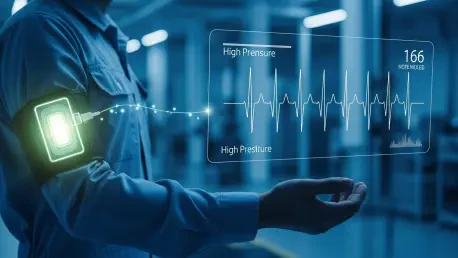
To address the persistent challenge of signal interference, researchers at the National University of Singapore have pioneered a system known as the Metahydrogel Artefact-mitigating Platform, or MAP. This innovation represents a departure from traditional approaches that rely heavily on complex software algorithms to clean up corrupted data after it has been collected. Instead, the focus has shifted toward refining the physical interface between the electronic sensor and the wearer’s skin through advanced material engineering. By creating a specialized material that mimics the properties of human tissue, the platform serves as a biological buffer, ensuring that the recorded data remains pure and representative of the user’s actual physiological state throughout the day. This physical noise mitigation is essential for capturing the faint signals that indicate mental strain. Hardware-level filtering prevents the data corruption that typically plagues consumer wearables during movement.
The transition from software-centric correction to hardware-based noise mitigation marks a significant turning point in the field of wearable health technology. The metahydrogel material is engineered to maintain a stable connection even when the subject is engaged in vigorous physical activity, such as running or performing heavy manual labor. In conventional devices, movement often causes the sensor to shift, leading to gaps in data or the introduction of false readings that render the information useless for medical analysis. The new platform effectively anchors the sensor while allowing it to remain flexible and comfortable for long-term wear. This stability is crucial for capturing the subtle changes in vital signs that occur when a person begins to experience mental fatigue. By prioritizing the integrity of the data collection process, the system provides a reliable foundation upon which more complex diagnostic assessments can be built, moving the industry closer to truly autonomous monitoring.
The Mechanics of Filtration: Dual-Action Performance
The internal architecture of the MAP system is what sets it apart from standard medical adhesives and conductive gels used in current clinical settings. At the core of this platform is a dual-action filtering mechanism that works on both mechanical and electrical levels to isolate clear biosignals. To combat mechanical interference, the material incorporates self-assembling nanoparticles that are specifically designed to scatter and absorb the vibrations caused by muscle movement and external impacts. This structural design prevents physical tremors from reaching the sensing element, thereby preserving the clarity of the underlying signal. Furthermore, the inclusion of a specialized electrolyte within the hydrogel matrix allows the device to effectively block high-frequency electrical noise generated by muscle contractions. This multi-layered defense ensures that the faint signatures of the heart and brain are captured without being obscured by the body’s own operational noise.
This sophisticated filtration allows the sensor to maintain a continuous and clear connection to the wearer’s cardiovascular signals, even during periods of intense exertion. In the past, achieving this level of clarity required the patient to remain perfectly still in a clinical environment, which is impractical for monitoring mental fatigue in real-world scenarios. The ability to filter out noise at the skin-sensor interface means that the data collected is of much higher quality from the start, reducing the computational load required for post-processing. This efficiency is particularly important for portable devices that must operate on limited battery power while providing real-time feedback to the user. By solving the noise problem at its source, the researchers have created a platform that is not only more accurate but also more practical for integration into daily garments. This breakthrough paves the way for a new generation of smart wearables that function as invisible guardians.
From Raw Data to Clinical Intelligence
Precision Metrics: Achieving Medical-Grade Accuracy
The enhanced signal quality provided by the metahydrogel platform allows it to achieve a level of diagnostic precision that was previously only available through high-end hospital equipment. While most consumer-grade wearables suffer a decline in signal-to-noise ratios during physical activity, the MAP system consistently delivers a clear and stable output. This fidelity is so high that it meets the rigorous international standards required for non-invasive blood pressure monitoring, a feat that very few wearable technologies have managed to accomplish. For healthcare professionals, this level of accuracy is the minimum requirement for making informed decisions about a patient’s well-being. The ability to monitor blood pressure and heart rate variability with such precision allows for the detection of subtle physiological shifts that correlate with the onset of cognitive exhaustion. These micro-changes in the cardiovascular system serve as reliable indicators of depletion.
Beyond simply meeting medical standards, the high-fidelity data captured by these sensors provides a comprehensive view of the body’s response to stress. In a professional context, understanding the relationship between physiological strain and mental performance is key to preventing accidents caused by human error. The system’s ability to maintain a high signal-to-noise ratio means that even the most minute variations in heart rhythm can be tracked and analyzed. This level of detail is essential for identifying patterns of fatigue that may not be apparent to the individual themselves. Often, people are unaware of their own declining alertness until it is too late, making an objective and automated monitoring system an invaluable tool for safety-critical roles. By providing a continuous stream of reliable data, the platform empowers individuals and organizations to take proactive measures to maintain performance and prevent the long-term consequences of chronic overexertion.
Advanced Algorithms: The Role of Deep Learning
Raw data, no matter how clean, requires sophisticated interpretation to be useful, and this is where the MAP system utilizes advanced artificial intelligence to its full potential. The hardware is seamlessly integrated with a deep-learning algorithm specifically trained to recognize the complex signatures of mental stress and fatigue within physiological signals. In controlled trials involving simulated driving tasks, the algorithm demonstrated a remarkable ability to classify different levels of exhaustion with an accuracy rate of 92%. This performance is a significant improvement over conventional sensors, which often struggle to distinguish between the physical effects of movement and the physiological indicators of mental strain. The AI is designed to look beyond simple metrics, analyzing the subtle nuances in signal morphology that characterize a tired brain with precision. This synergy between material science and software represents a holistic approach to health.
The research team successfully demonstrated that the metahydrogel platform was capable of monitoring a diverse array of biosignals, ranging from brain waves to respiratory sounds. By collaborating with mental health professionals, the developers linked physiological data to specific clinical conditions, ensuring the technology met medical needs. Industrial partnerships were sought to scale production, bringing this monitoring tool to both the clinical world and the consumer market. Organizations were encouraged to adopt these sensors as part of a proactive strategy to mitigate the risks associated with workplace burnout. This approach allowed for a shift from reactive healthcare to a model of continuous, preventative monitoring. Stakeholders should now move toward integrating these high-fidelity sensors into professional safety protocols and personalized wellness programs to capitalize on the benefits of data-driven fatigue management and long-term health preservation.