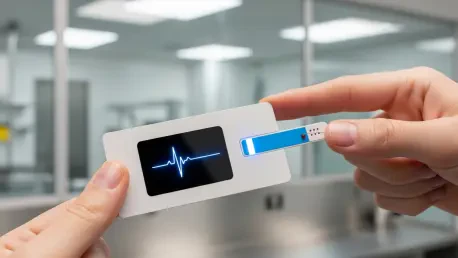

Every forty seconds, an individual in the United States experiences a myocardial infarction, necessitating a diagnostic race against time that often begins in a high-stress emergency room environment. Traditional diagnostic protocols rely on centralized laboratory testing for troponin, a protein released into the bloodstream when heart muscle damage occurs, which can take several hours to process. However, a revolutionary shift is occurring with the development of a diagnostic tool no larger than a standard credit card, capable of identifying these critical biomarkers within minutes at the point of care. This miniaturized technology represents a departure from the bulky equipment of the past, integrating sophisticated biosensors with microfluidic systems to provide immediate clarity during medical crises. By enabling rapid assessment outside the traditional hospital infrastructure, this device aims to bridge the gap between the onset of symptoms and the delivery of life-saving medical intervention.
Technical Innovation: The Mechanics of Portability
The core of this palm-sized innovation lies in its ability to harness electrochemical sensing technology to detect ultra-low concentrations of cardiac troponin I and T. Unlike conventional lateral flow assays that offer simple qualitative results, these modern devices utilize gold-functionalized electrodes coated with specific antibodies that bind to cardiac proteins. When a single drop of blood is applied to the sensor, the resulting chemical reaction generates an electrical signal proportional to the amount of troponin present in the sample. This quantitative data is then processed by an onboard microprocessor that interprets the severity of the cardiac event in real-time. This level of precision was previously restricted to large-scale immunoassay analyzers found in pathology departments, but the miniaturization of signal processing chips has allowed for laboratory-grade accuracy within a portable form factor. Such advancements ensure that the device remains sensitive enough to detect even minor elevations in biomarkers today.
Beyond the electrical components, the integration of advanced microfluidics plays a pivotal role in ensuring the reliability of these miniature diagnostic cards. These systems are designed to automate the preparation of the blood sample, filtering out cellular components that might interfere with the sensing surface without requiring manual centrifugation. By controlling the flow of fluid at a microscopic level, the device maximizes the interaction between the blood and the diagnostic reagents, reducing the margin of error commonly associated with human handling in high-pressure situations. Furthermore, the use of biocompatible polymers and stable reagents allows these devices to maintain their efficacy over long periods without the need for specialized refrigeration. This robustness is essential for deployment in diverse environments, ranging from remote rural clinics to standard household medicine cabinets. As these sensors continue to evolve, the inclusion of multi-marker panels will soon allow for the detection of other indicators.
Strategic Impact: Implementation and Future Directions
As the medical community integrated these portable diagnostic tools into standard emergency protocols, the emphasis shifted toward ensuring rigorous validation against gold-standard laboratory methods. Clinical studies conducted throughout the current year demonstrated that the sensitivity and specificity of these handheld devices rivaled those of established hospital systems. Regulatory bodies prioritized the review of these technologies, recognizing their potential to alleviate the burden on overcrowded emergency departments and improve patient outcomes across diverse demographics. The transition required updated training for medical staff and the development of secure data integration protocols to ensure that results were seamlessly recorded in electronic health records. Healthcare systems also began exploring cost-effectiveness models, finding that the initial investment in portable technology was offset by the significant reduction in hospital stays and the avoidance of expensive, unnecessary procedures for many patients.
Looking toward the broader landscape of cardiac diagnostics, the focus turned to expanding the accessibility of these devices to underserved populations globally. Manufacturers worked to simplify the user interface and lower production costs through high-volume manufacturing techniques, ensuring that the benefits of rapid heart attack detection were not limited by geographic or economic barriers. Actionable strategies were implemented to integrate these sensors into home-based monitoring programs, allowing patients with chronic conditions to detect potential issues before they became life-threatening. Researchers also explored the possibility of connecting these devices with artificial intelligence platforms to predict long-term cardiac trends. The successful adoption of credit-card-sized detectors set a precedent for the miniaturization of other critical tests, suggesting a wider trend toward the decentralization of medicine. These steps ensured that the healthcare system remained resilient and responsive to patient needs.