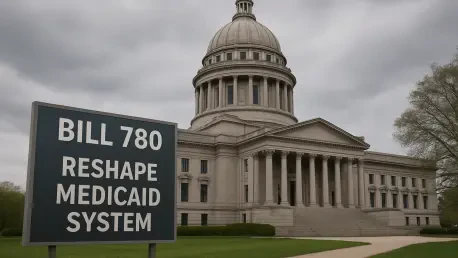

The introduction of House Bill 780, widely known as the Medicaid Savings Act, has sparked a profound legislative debate that could fundamentally alter the delivery of medical services for nearly three million Ohioans who rely on the state’s safety net. As lawmakers deliberate over this ambitious proposal championed by State Representative Karen Brownlee, the state finds itself at a critical juncture where fiscal austerity meets the complex realities of public health management. By seeking to dismantle the established managed care framework, the bill represents a radical departure from the status quo, aiming to replace private insurance oversight with a traditional fee-for-service model. This legislative push is not merely a technical adjustment but a comprehensive overhaul that challenges the existing partnership between the public sector and private industry. The outcome of this debate will determine how tens of billions of taxpayer dollars are allocated and whether the state can successfully manage the health risks of its most vulnerable populations while maintaining fiscal health.
Administrative Simplification: The Drive for Efficiency
The central pillar of the Medicaid Savings Act revolves around the elimination of profit margins currently retained by private insurers, advocating for what proponents describe as a single line of administration. This transition would require the Ohio Department of Medicaid to terminate its longstanding contracts with various managed care organizations that have served as the primary gatekeepers for patient care over the past several years. Instead of the current capitated payment structure, where insurers receive a set fee per member, the state would assume direct financial responsibility for every medical claim processed. This move is designed to simplify a system that many legislators view as unnecessarily fragmented and layered with corporate bureaucracy. By consolidating administrative functions, the state hopes to redirect funds that previously went toward insurance company overhead into direct clinical services. This shift promises a more transparent accounting of where every dollar is spent within the massive program.
Under the proposed administrative services organization model, the state would hire specialized entities to manage the technical back-end tasks, such as claims adjudication and provider network maintenance, on a strictly flat-fee basis. This approach is intended to strip away the incentive for private entities to restrict care in pursuit of higher margins, placing the burden of care coordination squarely on the shoulders of state officials. The newly designed system would potentially offer a unified benefit package, eliminating the variations that currently exist between different managed care plans and theoretically making it easier for providers to navigate a single set of rules. However, the logistical challenge of building out the internal capacity to handle such a massive operation cannot be overstated, as the state would need to rapidly scale its oversight capabilities to manage a member base of nearly three million people. The goal is to create a more responsive unit that integrates behavioral and medical services under one regulatory umbrella.
Regional Economic Risks: The Impact on Local Stability
While the promise of administrative efficiency is a major talking point for the bill’s supporters, the potential economic fallout in regions like Dayton has become a significant source of concern for local leaders and economic development experts. CareSource, a major nonprofit insurer headquartered in Dayton, serves as a vital economic engine for the area, employing thousands of high-skilled professionals who specialize in health policy and claims management. If the state proceeds with the plan to eliminate managed care contracts, the sudden removal of billions of dollars in annual revenue currently managed by local firms could trigger a sharp financial contraction for the city. This would not only lead to direct job losses within the insurance sector but would also have a cascading effect on local service industries that rely on the spending power of these employees. The concern is that while the state budget might see savings, the regional economy could suffer a blow that takes years to recover from.
Beyond the immediate impact on employment, the proposed shift threatens to dismantle the specialized health management infrastructure that has been built over decades in partnership with the private sector. Managed care organizations often invest heavily in community-based programs and social determinants of health, ranging from housing assistance to food security initiatives that go beyond basic medical claims. Proponents of the current system argue that these investments are only possible because of the long-term stability and profit incentives built into the managed care framework. If these organizations are reduced to mere claims processors or eliminated entirely, there is a risk that many of these supplemental community supports will vanish, leaving the state to fill the gap with limited resources. The debate therefore extends beyond simple accounting to a broader question of how the state intends to support the holistic needs of its residents without the localized expertise and investment private insurers currently provide.
Comparative Performance: Lessons and Long-Term Considerations
To justify the transition to a fee-for-service model, lawmakers pointed to the precedent set by Connecticut, which moved away from managed care and subsequently reported administrative costs far below the national average. By adopting a self-insured model, Connecticut was able to regain control over its data and negotiate more directly with providers, a strategy that House Bill 780 sought to replicate in the Ohio context. This historical example served as a blueprint for how a state could theoretically lower its per-member spending while maintaining a functional provider network without the intervention of commercial health plans. However, the scalability of such a model in a state as large and diverse as Ohio remained a point of intense scrutiny, as the administrative requirements for managing three million lives were significantly more complex than those found in smaller jurisdictions. Supporters of the bill argued that the data transparency gained from direct administration would allow Ohio to identify and eliminate wasteful spending patterns.
Looking ahead, the successful implementation of this new framework depended on the state’s ability to forge stronger direct relationships with hospitals and physician groups across the region. Policymakers had to prioritize the development of value-based purchasing agreements that rewarded providers for positive health outcomes rather than the volume of services rendered. This approach was essential to preventing the fee-for-service model from becoming an uncontrolled driver of inflation, and it required a robust technological infrastructure to track patient progress in real time. Future considerations involved the potential for a hybrid model that utilized private-sector efficiency for specific high-cost populations while maintaining the core of the program under state control. By focusing on data-driven decision-making and continuous quality improvement, Ohio aimed to create a sustainable model that balanced the need for fiscal discipline with the commitment to providing high-quality care. The journey toward this goal necessitated ongoing collaboration between public and private sectors.