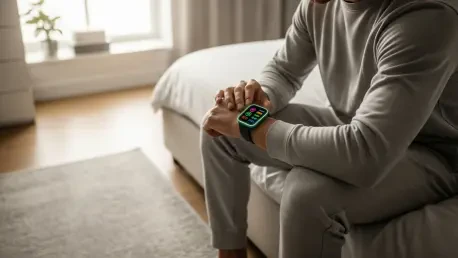

Walking into a modern bedroom today often reveals a person waking up not by stretching their limbs and sensing their energy, but by immediately glancing at a wrist-worn display to see how they slept. This digital intermediary has become so pervasive that many individuals now wait for a sleep score or a recovery percentage before deciding whether they feel refreshed or exhausted for the coming day. It is a peculiar modern phenomenon where a silicon chip and a few infrared sensors have effectively replaced the millennia-old evolutionary system of interoception. While these devices were marketed as tools for empowerment and self-discovery, they have inadvertently created a hierarchy of information where the algorithm is the master and the human experience is merely a variable. This reliance creates a strange psychological tension, as people begin to distrust their own biological signals if they happen to contradict the neatly packaged data points flashing on their screens.
The Psychological Shift Toward Numerical Truth
Society has long harbored a deep-seated belief that anything quantifiable is inherently more truthful than something qualitative or subjective. Because smartwatches use sophisticated photoplethysmography sensors and complex machine-learning models to analyze heart rate variability, users naturally assume the resulting data represents a scientific reality that their “vague” feelings cannot possibly match. This bias leads to a state where a person might feel perfectly fine but become suddenly anxious upon seeing a “high stress” notification. Individuals effectively delegate the right to interpret their own internal biology to a commercial product, operating under the assumption that the device knows more about their cardiovascular and nervous systems than their own conscious minds ever could. This shift is not just about convenience; it represents a fundamental change in how people perceive the self, transforming living, breathing bodies into sets of metrics that must be optimized.
It is essential to understand that these digital scores are almost entirely based on generalized statistical models and limited sensor inputs rather than comprehensive, personalized medical evaluations. A recovery percentage or a readiness score is merely an interpretation of data points like resting heart rate and movement, yet it often carries the weight of a professional medical diagnosis for the average user. This creates a profound disconnect where individuals begin to question their own reality, wondering if their perceived fatigue is actually real or if it only becomes valid once their device provides confirmation. This algorithmic validation creates a feedback loop where confidence in physical capability is no longer an internal feeling but an external permission granted by a piece of technology. When the device becomes the ultimate judge of health status, it strips away autonomy and makes users subservient to a mathematical average that may not account for unique biological or contextual factors.
The Impact of Algorithmic Interpretation
Constant feedback through a digital filter fundamentally changes how people perceive normal, healthy bodily functions and their natural variations throughout the day. Natural fluctuations, such as feeling slightly winded after a busy morning or experiencing a restless night due to excitement, are often labeled as “poor recovery” or “excessive strain” by the device’s rigid software. This causes the human brain to view the body through a lens of pathology rather than acknowledging the natural ebb and flow of life, leading to a crisis of confidence where users wait for a vibration on their wrist to tell them if they are fit or fatigued. This constant labeling of normal states as “sub-optimal” can lead to chronic low-level anxiety, as users feel they are failing at health simply because they do not meet the arbitrary standards of an “ideal” day. The technology essentially trains the mind to view the body as a fragile machine that is constantly on the verge of breaking down.
This cycle often results in a self-fulfilling prophecy that can actively ruin a person’s day before it has even truly begun in earnest. If a user sees a poor sleep score first thing in the morning, they may subconsciously adopt the persona of a tired person, feeling more sluggish and less productive regardless of their actual cellular energy levels. The watch does not just record the physical state; it actively shapes behavior and mood by setting expectations that the body then struggles to overcome through purely psychological suggestion. Moreover, the social comparison aspect of these devices, where scores are shared among friends or online communities, adds a layer of performance pressure to what should be a private physiological experience. Instead of listening to the body’s need for rest or movement, users often push themselves or hold themselves back based on what will look better on a digital dashboard, further distancing themselves from their authentic and vital physical needs.
Technical Boundaries and Medical Risks
From a strictly medical perspective, it is crucial to remember that smartwatches are designed as screening tools and lifestyle aids, not as definitive diagnostic machines. Health experts often point out that while modern trackers are excellent for identifying long-term trends in activity levels or heart rate patterns, they possess significant technical limitations that the general public often ignores. Factors like the tightness of the watch band, physical movement during a reading, poor skin contact, or even simple dehydration can easily skew the data, leading to inaccurate readings that cause unnecessary health scares. Even something as common as a tattoo or a darker skin tone can interfere with the optical sensors used to measure blood oxygen or heart rate, resulting in data that is fundamentally flawed. When users treat these potentially inaccurate numbers as absolute truth, they may seek medical attention for non-existent problems or develop a false sense of security that is risky.
The greatest danger arises when users either obsess over these flawed readings or, in a more concerning turn, ignore genuine physical symptoms because their device shows a “normal” status. A watch cannot perform a physical exam, listen to a heart with a stethoscope, or take a detailed medical history that considers genetic factors and lifestyle nuances. Relying solely on a digital score can lead someone to overlook serious warning signs, such as chest pain, unexplained dizziness, or persistent shortness of breath, simply because an algorithm has not yet flagged it as a significant problem. This over-reliance creates a dangerous gap where the device acts as a firewall between the patient and their own survival instincts. By prioritizing the green checkmark on an app over the alarming signals sent by the nervous system, users risk missing critical windows for medical intervention. Technology should be a secondary layer of protection, but it can never replace the immediate feedback of the body.
Reclaiming Physical Autonomy Through Mindfulness
To maintain a healthy balance, successful users adopted a “body-first” strategy by prioritizing internal signals over fleeting digital snapshots. This involved looking at long-term trends over weeks or months rather than obsessing over daily fluctuations that were often just statistical noise. Individuals who remained healthy and mentally balanced made it a point to check in with their own energy levels and physical sensations before even glancing at their watch in the morning. By treating technology as a secondary support system rather than a final authority, people reclaimed their autonomy and ensured that health trackers remained helpful tools instead of psychological burdens. They recognized that a low score was merely a prompt for reflection, not a definitive verdict on their vitality or their potential for the day. This shift in perspective allowed for a more harmonious relationship with technology, where data served the human rather than the human serving the data points.
Users found that setting specific boundaries, such as turning off non-essential health alerts or designating “analog days” without the watch, significantly reduced tracking-induced anxiety. They learned to use the data as a starting point for curiosity rather than a source of stress, asking why a score might be low instead of accepting it as an unchangeable fact. This proactive approach encouraged people to reconnect with their physical selves, using the device to confirm what they already sensed rather than to dictate their feelings. By emphasizing physical intuition, they avoided the trap of digital dependency and maintained a clear understanding of their own health status that was independent of any specific brand or ecosystem. Ultimately, the most effective way to use modern health technology was to ensure it amplified self-awareness rather than replacing it. These strategies ensured that the pursuit of health remained a personal journey guided by the body’s wisdom rather than an algorithmic simulation.