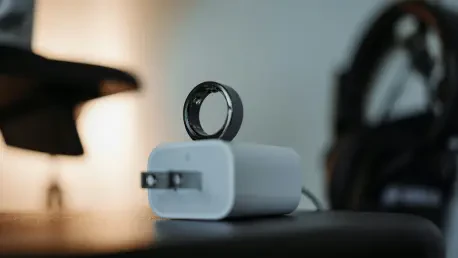

While it lacks the built-in GPS and electrocardiogram functions found in competitors, the Oura Ring 5 excels as a dedicated tool for analyzing long-term recovery and sleep architecture. That trade-off defines the entire device. Instead of trying to behave like a tiny computer on the finger, it aims to disappear into daily life while still collecting the kind of biometric signals that can shape better habits over time. For many users, that is the real appeal. A tracker that stays quiet at work, feels natural in bed, and does not demand constant attention can be more useful than a fuller-featured watch that gets removed before sleep. The ring’s promise is not novelty. It is consistency, and that makes the discussion around it more interesting than a simple feature comparison.
A Smaller Device With Bigger Ambitions
The strongest argument for the Oura Ring 5 begins with the hardware itself. The ring is roughly 40% smaller than its predecessor and weighs about 2g to 2.69g, depending on size, yet it still manages to house a more refined sensor package inside a titanium shell. That reduced footprint matters because comfort is not a side benefit here. It is the whole strategy. The upgraded sensor layout uses recessed domes instead of a bulkier band, and those domes sit about 1mm deep so the ring can maintain steady skin contact without adding much thickness. Paired with stronger LEDs and photodiodes, the design is meant to improve signal quality while preserving a look that still reads as jewelry rather than medical equipment.
That kind of restraint shapes the user experience in practical ways. The ring can stay on during sleep, weight training, showers, and swimming because it carries an IP68 rating and a scratch-resistant exterior. It does not buzz for alerts, glow on the wrist, or crowd the hand with a display that has to be checked. That invisibility is the point. A smartwatch often asks for attention every hour, while this ring tries to become part of the background. The result is a wearable that many people will forget they are wearing, which sounds modest until the device has to be worn every day for the data to mean anything.
The Data Behind The Quiet Design
Once the hardware fades into the background, the software has to do the real work. The Oura Ring 5 tracks heart rate, heart rate variability, VO2 Max, blood oxygen levels, respiratory rate, body temperature changes, steps, calories, and automatic activity detection. It also goes deep on sleep, mapping cycles, timing, and chronotype so the app can turn raw signals into a readiness score or a recovery trend. That is where the ring starts to justify its place. It does not simply report numbers. It interprets them. A user who sees a lower readiness score after a poor night or a body-temperature shift after a hard training block gets a clearer sense of cause and effect than a basic step counter can provide.
Recent software additions have pushed that interpretation further. Live activity tracking is managed through the smartphone, and the broader health focus now includes features tied to women’s wellness, such as menstrual cycle tracking that can account for birth control and a menopause impact scale. Those additions make the ring feel less like a generic fitness gadget and more like a longitudinal health tool. The most valuable insight often appears over weeks, not minutes. A single night of data may not say much, but repeated patterns can reveal stress, training load, or recovery gaps that would otherwise stay hidden.
Accuracy, Convenience, And The Limits Of Silence
In day-to-day use, the Oura Ring 5 has shown accuracy strong enough to sit beside respected fitness trackers and dedicated heart rate monitors. Its ability to flag stress events is especially useful because those moments are not always dramatic. Sometimes the body is simply carrying more strain than expected, and a ring that notices small shifts in heart rate or recovery can help a user adjust before fatigue builds. That makes the device valuable for people who want signals they can act on without checking a screen every few minutes. It is particularly effective during sleep, when wrist-worn devices can feel intrusive and hand-based comfort becomes a real advantage rather than a marketing line.
Still, the ring is not flawless. Automatic workout detection can misread simple movement as exercise, which creates phantom activities, and it can also miss the exact moment a session ends. Those errors are annoying, but they are manageable because the app allows manual edits. The deeper limitation is structural. A screenless ring cannot replace instant on-wrist feedback, and it cannot match the independence of a watch with GPS, ECG, or fall detection built in. For running or cycling, distance and pace depend on a connected phone, which means the experience is more passive than athletic. That is not a defect so much as a reminder that specialization always comes with boundaries.
Price, Subscription, And Who It Truly Serves
The biggest obstacle for most buyers is not the engineering. It is the cost. Standard finishes such as Silver and Black begin around £399, while premium versions like Gold, Brushed Silver, Rose Gold, and Stealth rise to about £499. On top of that, the subscription is effectively required if the ring is going to deliver the insights that make it worth buying in the first place. At £5.99 per month or £70 per year, the recurring fee keeps the device from being a one-time purchase in the way many people expect hardware to be. Without it, the experience drops to basic data, and the ring loses much of its appeal.
That pricing structure places the Oura Ring 5 in a narrow but defensible category. It is not built for users who want every metric in real time or athletes who need a watch to act like a training console. It is better suited to people who care about sleep quality, recovery, stress patterns, and a design that can stay on from morning to night without drawing attention. The best next step for anyone evaluating it had been to compare use case first and price second. Buyers who valued comfort, discretion, and long-view health trends had likely found the ring easier to live with than a smartwatch, while anyone who needed GPS, ECG, or emergency alerts had been better served elsewhere.