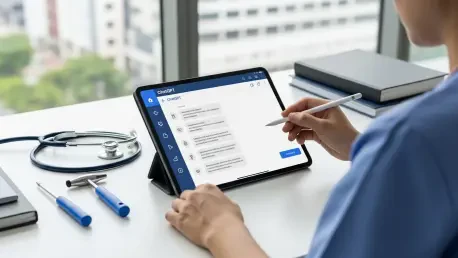

James Maitland stands at the forefront of the intersection between robotics, the Internet of Things, and the future of patient care. As a seasoned expert who has watched medical technology evolve from simple digital records to complex diagnostic assistants, he brings a grounded yet visionary perspective to the recent rollout of specialized AI workspaces for healthcare providers. His background in integrating automated systems into clinical environments provides a unique lens through which to view the shift toward high-efficiency, AI-supported medicine. By examining how these tools bridge the gap between heavy administrative burdens and meaningful patient interaction, he helps us understand a world where technology acts as a silent partner in the exam room.
The following discussion explores the practical integration of generative models into daily clinical routines, the balance between automated efficiency and personalized care, and the evolving landscape of medical research and certification. We delve into the necessity of maintaining rigorous safety standards through physician-led benchmarking and the critical importance of data security in a landscape increasingly defined by digital interaction.
Verified medical professionals like physicians and pharmacists now have access to specialized AI workspaces for documentation and research. How will this immediate accessibility impact the daily routine of a high-volume clinic, and what specific steps should providers take to verify the accuracy of AI-generated summaries?
The immediate accessibility of these workspaces acts like a pressure valve for high-volume clinics where the weight of documentation often leads to burnout. With 81% of physicians already reporting that they use AI in a professional context, we are seeing a shift where the “digital scribe” becomes a standard team member rather than an experimental luxury. To ensure safety, providers must adopt a “trust but verify” protocol, especially since even the most advanced models are designed to support judgment rather than replace it. Clinicians should perform spot checks against the original patient notes, focusing specifically on medication dosages and allergy lists, which are the most sensitive data points. It is also vital to utilize the multi-stage adjudication features where available, ensuring that the AI’s output aligns with the 99.6% accuracy rate observed during the testing of nearly 7,000 real-world clinical conversations.
Clinicians are increasingly turning repetitive tasks like referral letters and prior authorizations into automated, reusable workflows. What are the potential trade-offs regarding the personalization of patient care, and what metrics should a practice use to ensure these automated outputs meet professional standards?
Automation offers a tempting escape from the “paperwork tax,” but the primary trade-off is the potential loss of the unique patient voice that a seasoned clinician captures in their narrative. When a workflow becomes too standardized, there is a risk that the nuanced social determinants of health—like a patient’s living situation or emotional state—might be filtered out for the sake of speed. Practices should monitor “revision rates” as a key metric, tracking how often a physician feels the need to manually edit an AI-generated referral before it is sent. If the revision rate is low, it suggests the model is capturing the necessary clinical nuance, but if it is too high, the workflow needs to be recalibrated to include more personalized input triggers. Ultimately, the goal is to use the time saved on administrative tasks to actually look the patient in the eye during the consultation, restoring the human connection that technology sometimes obscures.
Some advanced AI models are currently outperforming human experts in citing peer-reviewed evidence during clinical research. How should a practitioner reconcile their own medical intuition with a conflicting AI recommendation, and what is the best process for integrating these tools into a multi-disciplinary team?
Reconciling medical intuition with AI data is one of the most significant psychological hurdles for modern doctors, particularly when studies show AI can cite sources more accurately than humans in certain test cases involving hundreds of specific citations. When a conflict arises, the practitioner should use the AI’s clinical search tool to trace the recommendation back to its peer-reviewed source among the millions of available documents. This allows the doctor to see if the AI is picking up on a very recent study that contradicts long-held “common knowledge” in the field. Integration into a multi-disciplinary team should involve using the AI as a “neutral party” during case reviews, where the model provides an evidence-based baseline that the specialists then refine based on their years of hands-on experience. This collaborative approach turns the AI into a librarian of sorts, surfacing the evidence while the human team makes the final high-stakes decisions.
While many clinical tasks do not require protected health information, certain platforms now offer HIPAA-compliant environments via Business Associate Agreements. In what specific scenarios should a clinician prioritize a compliant workspace, and how can they ensure that patient data remains secure during long-term research?
A clinician should prioritize a HIPAA-compliant workspace the moment a task moves from general medical inquiry to specific patient management, such as drafting a personalized treatment plan or summarizing a patient’s longitudinal history. While general research can be done in a standard environment, the use of a Business Associate Agreement (BAA) is non-negotiable whenever Protected Health Information (PHI) is uploaded to facilitate complex decision support. To ensure long-term security, clinicians must utilize features like multi-factor authentication and verify that their chosen platform explicitly excludes their data from being used to train future iterations of the model. Security in research is not just about the initial entry; it’s about a continuous audit trail that ensures data remains siloed and encrypted even as the research project spans several years. It is comforting to know that in these controlled environments, physicians can work with the peace of mind that the 700,000 model responses reviewed for safety are part of a rigorous, protected ecosystem.
Researching clinical questions through AI tools can now automatically satisfy continuing medical education requirements without the need for additional paperwork. How will this streamlined process change the way doctors stay current in their specialties, and what are the long-term implications for traditional medical board certifications?
The ability to earn Continuing Medical Education (CME) credits through organic clinical research is a game-changer that aligns learning with the actual moment of care. Instead of losing a weekend to a crowded seminar, a doctor learns the latest protocols for a specific rare condition while they are treating a patient with that exact diagnosis, making the information far more likely to stick. This shift suggests a move away from “periodic testing” toward “continuous competency,” where a physician’s daily engagement with peer-reviewed evidence serves as a living record of their expertise. Long-term, we might see traditional board certifications evolve into more dynamic, data-driven credentials that reflect a provider’s ongoing mastery of their field through documented AI-assisted research. This creates a more agile medical workforce that can pivot quickly as new treatments and pharmaceutical breakthroughs emerge in real-time.
New benchmarking tools use physician-authored rubrics to measure AI safety in care consults and medical documentation. How can healthcare administrators use these benchmarks to compare different technology providers, and what step-by-step training should staff undergo before using these models in a live patient environment?
Healthcare administrators should view these physician-authored benchmarks, such as HealthBench Professional, as the “gold standard” for procurement, looking for models that consistently outperform base versions in specific clinical categories like care consults and documentation. When comparing providers, admins should demand transparency regarding how many independent physicians validated the model’s safety—looking for benchmarks that involve thousands of adjudicated conversations. For staff training, the first step should be a mandatory “sandbox” period where clinicians use the tool on anonymized data to understand its strengths and weaknesses without risk. The second step involves training on “prompt engineering,” teaching staff how to frame questions to get the most accurate, evidence-backed results. Finally, a formal “adjudication phase” should be established where senior staff review the first several weeks of AI-assisted notes to ensure the output meets the specific stylistic and safety standards of that particular medical institution.
Specialized AI workspaces are being adopted by major medical centers to handle everything from administrative tasks to complex clinical decision support. What are the primary obstacles to implementing these tools in rural or underfunded healthcare settings, and how can these gaps be closed to ensure equitable care?
The primary obstacles in rural or underfunded settings are often a lack of robust digital infrastructure and the high cost of integrating new technology into legacy systems that were never designed for AI. While the accessibility of free tools for verified clinicians helps, the hardware and high-speed internet required to run these frontier models effectively can still be a barrier. To close these gaps, we need a concerted effort to provide “lite” versions of these tools that can operate on lower bandwidths without sacrificing the core clinical intelligence. Furthermore, larger institutions like Stanford or Cedars-Sinai could act as “hub” mentors, sharing their physician-authored rubrics and implementation strategies with smaller “spoke” clinics in rural areas. By democratizing access to the same 5.4-level models used in the world’s leading hospitals, we can ensure that a patient in a remote town receives the same evidence-based care as someone in a major metropolitan center.
What is your forecast for AI in clinical practice?
My forecast is that within the next five years, the distinction between “practicing medicine” and “using AI” will completely disappear, as these tools become as ubiquitous and invisible as the stethoscope or the electronic health record. We will see a shift toward “proactive” healthcare, where AI doesn’t just respond to a doctor’s query but flags potential issues in a patient’s chart before the clinician even opens it, citing peer-reviewed evidence to support its warnings. The role of the physician will evolve into that of a “clinical orchestrator,” someone who manages a suite of intelligent tools to deliver highly personalized, hyper-accurate care. Ultimately, the successful integration of AI will lead to a 30% to 40% reduction in administrative time, allowing the human element of medicine—empathy, touch, and intuition—to return to the center of the patient experience. The technology will not replace the doctor; it will finally free the doctor to be fully present with the patient.