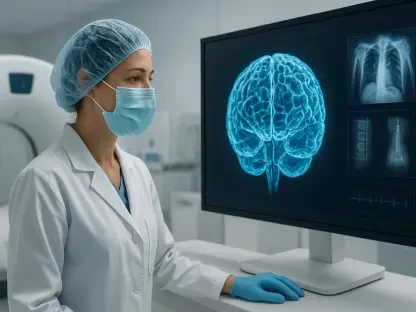

James Maitland is a pioneer in bridging the gap between sophisticated robotics and intuitive digital healthcare systems. With years of experience implementing IoT solutions in high-stakes clinical settings, he understands how data flow affects the daily pulse of a hospital. His work focus is on how technology can reduce the friction between complex medical data and the human connection required for healing. Today, we explore the evolution of AI-driven clinical workspaces, specifically how the latest integrations are reshaping the way medical professionals interact with complex patient records and public health databases to improve patient outcomes.
Our conversation centers on the integration of GPT-5 powered models into established healthcare infrastructures like Epic, the shift from manual data synthesis to AI-assisted documentation, and the critical role of specialized plugins in streamlining medical research. We also discuss the rigorous safety protocols involving a global network of hundreds of physicians and the technical safeguards that ensure these tools meet the highest standards of data privacy and regulatory compliance.
The integration of AI directly into electronic health records represents a massive shift in clinical documentation; how do you see this changing the daily routine for a physician walking into a consultation today?
The shift is about reclaiming time that was previously lost to “pajama time,” where doctors spent hours at home clicking through tabs. By integrating these AI capabilities directly into the Epic electronic health record, a physician can now enter a room with a summarized clinical timeline that pulls from notes, lab results, medications, and specialist documentation in seconds. We are seeing a read-only experience that doesn’t write back to the record yet, but it allows the clinician to identify key changes and prepare for appointments without leaving the patient’s digital chart. In practice, this means a doctor at a pilot partner like UCSF Health can focus on the patient’s eyes rather than the screen, feeling more present because the heavy lifting of data synthesis is already done. It’s a transition from being a data entry clerk back to being a healer, as the AI highlights what matters most across a complex, multi-year medical history.
Beyond individual patient charts, how does connecting AI to public health repositories like PubMed and ClinicalTrials.gov transform the way research and pharmacy teams operate?
This is where we see the “library” aspect of healthcare becoming a living, breathing assistant rather than a static stack of papers. By connecting to nine official public health sources, including RxNorm and DailyMed, teams can now work with specific records and versions without the tedious process of searching each database separately. Imagine a research team trying to identify actively recruiting trials for a rare condition; they can use the ClinicalTrials.gov plugin to compare eligibility criteria across dozens of studies in one go. Similarly, pharmacy teams are using these tools to confirm the latest labels and warnings for medications, ensuring that the information they provide is pulled from the most authoritative, up-to-date sources. It replaces the frantic toggling between browser tabs with a governed, compliant workspace that brings medical evidence directly to the point of care.
With AI’s entry into the clinical space, safety is the primary concern for everyone involved—what does the data tell us about the reliability of these models when handled by medical professionals?
The safety data we are seeing is actually quite remarkable because it’s backed by a global network of physician advisors across 60 countries and 26 medical specialties. These experts have reviewed more than 700,000 model responses to ensure the AI behaves in a way that aligns with real-world healthcare questions. When physicians evaluated the model across 27 clinical use cases—things like handoff summaries and medication reviews—they rated 99.1% of the responses as safe across more than 4,300 individual ratings. Furthermore, in specialized tests involving large U.S. healthcare datasets, more than 93% of the responses were rated as having “good” or better accuracy. This rigorous testing gives health systems the confidence to deploy these tools, knowing they have been vetted by their peers in high-stakes environments.
Healthcare is heavily regulated, so how can large health systems ensure that using these advanced AI tools doesn’t compromise data security or HIPAA standards?
Security in this space isn’t just a feature; it is the foundation upon which the entire system is built. These AI workspaces combine healthcare-specific capabilities with enterprise-grade controls like single sign-on, role-based access, and detailed audit logs to track every interaction. With the proper business associate agreements in place, organizations can use these tools in a way that is fully HIPAA-compliant, ensuring that patient privacy is never traded for technological convenience. Chief AI Officers are focusing on using these governed environments to reduce routine work while maintaining a “human-in-the-loop” philosophy. It’s about creating a secure “sandbox” where practical innovations can move quickly into action without exposing sensitive data to the public internet or unauthorized users.
What is your forecast for the evolution of AI-assisted medical intelligence over the next few years?
From 2026 to 2028, we will see the “connected” aspect of healthcare become almost invisible, where AI doesn’t feel like a separate tool but rather an ambient layer of support. We are moving toward a reality where medical intelligence isn’t just summarizing the past, but actively predicting the next steps in a patient’s care journey by synthesizing organizational knowledge with global medical evidence. The goal is to reach a point where technology handles the 80% of routine administrative work, allowing the remaining 20%—the human connection and complex decision-making—to be the sole focus of the provider. Ultimately, we are building a future where every clinician has a world-class research assistant at their side, making “whole-person care” a sustainable reality rather than just a mission statement.