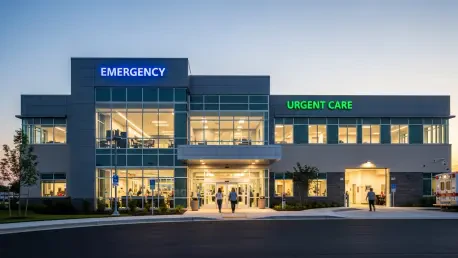

Patients often find themselves caught in a high-stakes guessing game when a sudden medical issue arises, weighing the long wait times of a traditional emergency room against the limited capabilities of a standard urgent care clinic. This common struggle has been directly addressed in Columbia with the launch of the state’s very first hybrid medical facility, which officially opened its doors to the public on June 18, 2026. The MUSC Health Emergency and Urgent Care-Garners Ferry center represents a significant evolution in local healthcare delivery, born from a strategic collaboration between MUSC Health-Midlands and Intuitive Health. By merging two distinct levels of care into a single physical location, the facility seeks to eliminate the confusion that frequently plagues families during medical crises. This pioneering model ensures that individuals no longer have to decide where to go before they are even seen by a professional, as the center provides the appropriate level of treatment based on the actual severity of the patient’s condition upon arrival.
Dual-Care Infrastructure: Bridging the Medical Divide
The physical footprint of this new medical landmark spans an impressive 12,484 square feet, strategically situated near Interstate 77 to maximize accessibility for residents in southeast Columbia and the surrounding Lower Richland area. Unlike traditional clinics that may close their doors in the evening, this center operates 24 hours a day, providing a constant safety net for the community. The interior is outfitted with sophisticated diagnostic technology that rivals major hospital departments, including a high-resolution 64-slice CT scanner, advanced ultrasound equipment, and a full-service laboratory capable of rapid results. Because the facility is seamlessly integrated into the broader MUSC Health network, patients benefit from a unified electronic medical record system and a direct pipeline to specialized hospital resources if an escalation in care is required. This integration allows for the stabilization of critical patients arriving by ambulance while simultaneously treating walk-in patients with minor ailments in an efficient environment.
Beyond its technical capabilities, the establishment of this hybrid center serves as a vital intervention for regional healthcare disparities that have historically impacted the local population. For many years, families living in the southeastern sectors of the city were forced to navigate significant distances and heavy traffic to reach a comprehensive emergency department, a delay that could prove catastrophic during time-sensitive cardiac or neurological events. By placing hospital-grade diagnostics and emergency-trained personnel directly within these underserved neighborhoods, MUSC Health is effectively shortening the “golden hour” for life-saving treatments. This localized approach does more than just save time; it fundamentally reorganizes how the regional healthcare system functions by diverting non-critical cases away from overcrowded downtown hospitals. Consequently, the primary emergency departments in the city center can focus their resources on the most complex trauma cases, while the Garners Ferry location provides an intimate and efficient setting.
Fiscal Transparency: Driving Statewide Healthcare Modernization
One of the most transformative aspects of the hybrid model is its commitment to financial transparency and the elimination of surprise medical billing for outpatient services. Upon arrival at the Garners Ferry facility, every patient is examined by an emergency-room-trained physician who determines the necessary level of care based on clinical presentation. If the condition is diagnosed as a minor ailment, such as a localized infection or a simple fracture, the patient is billed at urgent care rates, which are significantly lower than traditional emergency fees. Conversely, if the situation requires intensive intervention or complex stabilization, the billing reflects emergency room standards. This objective triage process removes the financial burden from the patient, who previously had to self-diagnose their financial risk before seeking help. By prioritizing ethical billing and clarity, the partnership between MUSC Health and Intuitive Health sets a new benchmark for patient advocacy, ensuring that high-quality medical expertise remains accessible.
The successful activation of the Columbia site signaled a broader shift in the healthcare landscape of South Carolina, prompting a rapid expansion of similar facilities across the state. Building on the operational foundations established at this and the previous Kiawah Island location, development teams focused on bringing hybrid centers to Florence, Summerville, and Charleston throughout the remainder of 2026 and into 2027. These projects were complemented by extensive renovations to existing Midlands facilities and the opening of new primary care offices, creating a comprehensive web of medical support. Stakeholders recognized that modernizing the infrastructure required more than just new buildings; it necessitated a cultural shift toward decentralized, community-based care. Healthcare administrators prioritized the recruitment of top-tier medical talent to staff these regional hubs, ensuring that the same level of excellence found at the Medical University of South Carolina was available in suburban and rural settings for everyone.