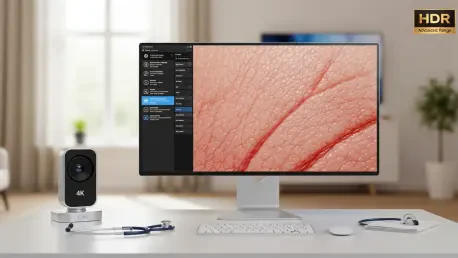

The rapid evolution of decentralized healthcare has fundamentally altered the patient experience, yet a significant technological bottleneck persists when standard-definition webcams fail to provide the granular detail necessary for complex medical assessments. While the transition toward virtual consultations has been accelerated by necessity, the primary challenge remains the visual limitations of consumer-grade hardware which often obscures critical clinical information. A basic video call might suffice for a mental health check-in or a routine follow-up, but it frequently falls short when a physician needs to inspect a surgical incision, identify a subtle rash, or evaluate the vascular patterns in a patient’s throat. This gap between the clinical need for precision and the current state of consumer technology can lead to diagnostic uncertainty, often forcing patients back into physical clinics for assessments that should ideally be handled remotely. For a specialist to make an informed decision from miles away, the visual data must be an exact representation of physical reality, requiring a level of fidelity that standard hardware simply cannot provide.
Current medical imaging demands go far beyond the capabilities of traditional video conferencing tools, as clinical accuracy relies heavily on the ability to perceive fine textures and subtle color changes that consumer devices often smooth over or distort. Without high-fidelity imaging, remote diagnosis remains limited to basic conversations rather than specialized medical evaluations that require detailed observation of tissue health. The introduction of 4K HDR camera modules, such as the specialized Vadzo Falcon-821CRS, aims to bridge this critical gap by bringing medical-grade imaging performance directly into the home and the local clinic. These devices are specifically engineered to handle the unpredictable conditions of remote environments, ensuring that the visual data provided to a doctor is both clear and reliable enough to support a formal diagnosis. By prioritizing spatial resolution and dynamic range, these advanced sensors transform the remote examination from a low-resolution conversation into a professional-grade diagnostic session.
The Challenge: Overcoming the Limitations of Unpredictable Lighting
One of the most persistent obstacles in modern telehealth is the mixed lighting dilemma, where bright specialized exam lights frequently clash with dim or uneven room backgrounds. In a standard home or outpatient setting, this extreme contrast often causes traditional cameras to blow out the highlights or lose all discernible detail in the shadows, making a thorough physical examination nearly impossible for the remote provider. For instance, when a patient uses a bright flashlight or a penlight to illuminate a specific wound or an area of concern, a typical consumer camera often renders that specific area as a white, featureless blur due to sensor saturation. This loss of information is not merely a technical annoyance but a significant clinical barrier that prevents the physician from seeing the actual margins of a lesion or the specific color of exudate, both of which are critical for determining the severity of a medical condition.
Advanced High Dynamic Range technology, specifically the implementation of on-chip LI-HDR, solves this problem by capturing multiple exposures of the same scene simultaneously at the sensor level. Unlike software-based HDR solutions found in many smartphones, which can cause significant motion blur or ghosting when a patient moves even slightly, this hardware-level approach preserves a crystal-clear image in real-time without artifacts. By balancing the brightest and darkest parts of the frame before the data ever leaves the camera, the technology ensures that the clinician can see the fine texture of a healing wound under a bright light while still maintaining clarity in the surrounding skin. This ability to maintain a high dynamic range of up to 120 dB means that no critical diagnostic detail is lost to poor lighting, satisfying a fundamental requirement for professional remote care where the environment cannot be strictly controlled like a hospital room.
Visual Precision: Enhancing Diagnostic Confidence Through Resolution
Resolution plays a critical role in the store and forward workflows that have become a staple of modern medical consultations, where high-quality images are captured by a technician or patient and sent to specialists for later review. A 4K sensor provides approximately 8 megapixels of data, offering a level of spatial detail that is fundamentally superior to the grainy output of standard 1080p video conferencing systems. This extra information allows for a much more granular inspection of a patient’s physical condition, providing the specialist with the raw data needed to identify minute abnormalities that would be invisible at lower resolutions. In a field like dermatology, where the diagnosis often hinges on the appearance of microscopic structures or the specific arrangement of skin cells, the shift to 4K resolution represents a massive leap in the utility of remote imaging systems.
For a wound care specialist or an oncologist, the ability to digitally zoom into a high-resolution image without a loss of clarity is essential for spotting subtle patterns that indicate disease progression. 4K technology ensures that zooming in does not result in a pixelated mess, allowing for the careful inspection of fine borders, tissue textures, and vascular anomalies that might otherwise be missed. This clarity can be the definitive difference between a routine observation and a life-saving discovery, providing the specialist with enough visual evidence to order an immediate biopsy or adjust a treatment plan. By delivering an image that remains sharp even under digital magnification, these camera modules provide a level of confidence that was previously only available during in-person examinations, effectively expanding the diagnostic reach of the world’s leading medical experts.
Color Fidelity: Establishing Truth in Clinical Imaging
Color accuracy is perhaps the most vital component of a medical image, as even a slight change in the shade of redness can indicate a developing infection or a localized allergic reaction. Consumer-grade cameras are notorious for artificially saturating colors or applying beautification filters designed to make subjects look healthier or more vibrant, but these enhancements are dangerous in a clinical context. Medical-grade camera modules are specifically tuned for clinical color profiles that prioritize absolute realism over aesthetic appeal, ensuring that what the doctor sees on their monitor is a perfect match for the patient’s physical appearance. This commitment to color truth allows clinicians to distinguish between different stages of bruising, identify subtle jaundice, or monitor the oxygenation of tissues by observing the exact hue of the skin and mucous membranes.
By avoiding artificial enhancements and aggressive noise reduction that can smudge clinical details, these specialized cameras provide a natural and representative view of various skin tones and medical conditions across diverse populations. This level of color fidelity gives doctors the same diagnostic confidence they would have during a traditional office visit, reducing the likelihood of false negatives or unnecessary follow-up appointments. Accurate color reproduction ensures that the digital image serves as a trustworthy reflection of the patient’s actual health status, facilitating better communication between primary care providers and specialists. When every pixel is calibrated to represent true-to-life clinical data, the camera stops being a simple communication tool and begins to function as a reliable diagnostic instrument that supports high-stakes medical decision-making.
Seamless Integration: Streamlining Hardware into Secure Medical Environments
Healthcare information technology departments operate under exceptionally strict security and administrative protocols that often prohibit the installation of third-party drivers or unverified software packages. To bypass these significant administrative hurdles, modern telehealth cameras utilize USB Video Class compliance, which offers a zero-driver experience that allows the hardware to function immediately upon being plugged in. This architectural decision makes the hardware compatible with existing hospital infrastructure and legacy systems without requiring specialized IT support or custom coding. By adhering to global standards, these 4K HDR modules can be deployed across large healthcare networks quickly, ensuring that the latest imaging technology is available to clinicians without the typical delays associated with software certification and deployment.
This plug-and-play capability ensures that the camera works instantly with established telehealth platforms, whether the endpoint is running on Windows, Linux, or mobile operating systems like Android. This ease of use is critical for medical personnel who need technology that functions reliably without constant troubleshooting, allowing their primary focus to remain on the patient rather than the complexities of hardware setup. Furthermore, the compact physical design of these modules allows for easy integration into a wide variety of medical tools beyond the standard desktop camera. From portable consultation kits used by home health nurses to large-scale telemedicine carts in emergency departments, the small form factor ensures that high-performance imaging can be placed wherever it is needed most, providing a versatile solution for manufacturers building the next generation of medical kiosks.
Adaptive Performance: Ensuring Reliability Across Diverse Network Conditions
The delivery of high-resolution video can be a significant challenge in rural or underserved areas where internet bandwidth is often limited, inconsistent, or prone to sudden drops in speed. To address this reality, professional camera modules support multiple output modes that range from full 4K resolution down to standard definition, allowing the imaging system to adapt to the specific network environment of the user. This flexibility is essential for maintaining a continuous clinical session, as it prevents the video feed from cutting out entirely when the connection becomes unstable. Telehealth software can dynamically switch between these resolutions to maintain a high frame rate during a conversation, ensuring that the visual interaction between the doctor and patient remains fluid and professional.
When a clinician needs to see a specific detail with absolute clarity, the system can be configured to prioritize a high-resolution still capture or a short 4K burst even if the live video stream is running at a lower resolution. This capability ensures that the connection remains stable and functional throughout the visit, even if the available network speed fluctuates during a critical part of the diagnostic process. By balancing the demands of high-resolution imaging with the realities of low-bandwidth efficiency, these cameras make specialized care accessible to patients who might otherwise be cut off from modern digital health infrastructure. This adaptability is a key factor in expanding the reach of healthcare services, ensuring that a high standard of care is available to everyone regardless of their geographical location or the quality of their local internet service.
Professional Standards: Developing a Robust Future for Remote Care
The transition toward 4K HDR technology represents the professionalization of telehealth hardware, transforming the camera from a simple peripheral into a legitimate diagnostic instrument. This shift was necessary for remote care to become a permanent and trusted fixture in modern medicine, as better hardware leads directly to improved patient outcomes and more accurate first-time diagnoses. By offloading complex tasks like HDR merging and color correction to the camera’s internal processor, these modules also reduce the computational burden on the host device. This means that even a low-powered tablet or a portable laptop can deliver high-quality video without the risk of overheating, lagging, or crashing during a consultation, providing a stable platform for long-term clinical use.
As medical device manufacturers continued to adopt these advanced imaging modules, the standard for remote care rose significantly across the entire healthcare landscape. Providing clinicians with the visual clarity they required ensured that virtual visits were just as effective as traditional office appointments for a wider range of medical conditions. The integration of high-fidelity hardware served as the foundation upon which the modern digital health infrastructure was successfully built, moving the industry toward a model where distance no longer limited the quality of a medical evaluation. Ultimately, the successful deployment of 4K HDR technology proved that technical limitations could be overcome with specialized engineering, allowing the medical community to embrace a more flexible and accessible future for patient care.