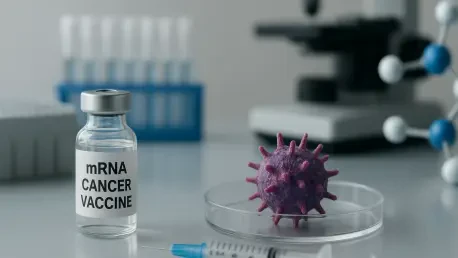

Unlike traditional vaccines designed for broad populations, personalized neoantigen therapies must be engineered to match the unique genetic signatures found only on an individual’s tumor cells. This biological precision represents the pinnacle of modern oncology, moving away from the “one-size-fits-all” chemotherapy models that have dominated the landscape for decades. As the medical community assesses the clinical triumphs of 2026, the primary focus has shifted from whether these vaccines work to how they can be produced at scale. The process begins with a biopsy of a patient’s tumor alongside a blood sample to sequence healthy DNA. Sophisticated computational algorithms then compare the two to isolate mutations that are entirely unique to the malignancy. These identified neoantigens serve as the target for mRNA synthesis, instructing the patient’s own immune system to recognize and eliminate cancerous cells. While this bespoke approach offers unprecedented accuracy, it necessitates a radical rethink of pharmaceutical infrastructure.
Production Logistics: Scaling the Bespoke Manufacturing Model
Manufacturing Architecture: Transitioning to the N-of-1 Strategy
The transition toward widespread market availability requires a fundamental departure from the traditional “scale-up” manufacturing paradigm. For nearly a century, the pharmaceutical industry has focused on perfecting facilities that produce massive quantities of a single, uniform substance. In contrast, personalized mRNA cancer vaccines demand a “scale-out” strategy, often referred to as “n-of-1” production. This model requires the simultaneous creation of thousands of unique, individual batches within a single facility. Each batch is a custom medication for a specific human being, necessitating a modular approach where different production lines operate in parallel. Achieving this level of complexity involves integrating high-tech computational sequencing directly into the manufacturing floor. Rather than simply mixing ingredients, the facility functions as a high-throughput genomic lab, transforming digital code derived from a patient’s biopsy into a physical therapeutic dose within a matter of weeks.
Quality Assurance: Chain-of-Identity and Purification Protocols
Maintaining a rigorous chain-of-identity is perhaps the most daunting logistical challenge within these “n-of-1” facilities. Because every vaccine is patient-specific, any error in labeling or distribution could lead to a patient receiving a treatment that is not only ineffective but potentially dangerous. Manufacturers have responded by implementing sophisticated automated tracking systems that follow a sample from the initial biopsy at the hospital through sequencing, synthesis, and eventual delivery. Furthermore, each unique batch requires its own dedicated purification process to ensure clinical safety and efficacy. In a traditional setting, purification equipment is cleaned after a massive run; in the world of personalized mRNA, the equipment must be capable of rapid turnover or utilize single-use components to prevent cross-contamination between different patients. This logistical burden adds layers of cost and complexity that the industry is currently working to streamline through robotics and advanced sensor technologies.
Commercial Viability: Balancing Speed and Financial Sustainability
Temporal Constraints: Accelerating the Biopsy-to-Injection Pipeline
In the treatment of aggressive or advanced-stage cancers, time remains the most critical variable for survival. The window between a patient’s diagnosis and the administration of the first dose of a personalized vaccine is known as the “turnaround time,” and the industry has set a collective ambition to reduce this period to six or eight weeks. To achieve such a rapid response, biotechnology leaders like Moderna have invested heavily in automated facilities designed for parallel processing, such as the specialized plant in Marlborough, Massachusetts. These sites are engineered to handle the genomic data processing and biochemical synthesis in a seamless loop. However, the broader industry, including Contract Development and Manufacturing Organizations, must still modernize their operations to support these bespoke requirements at scale. If a facility cannot reliably deliver a vaccine before a patient’s disease progresses, the clinical utility of the technology is diminished, making temporal efficiency as vital as biological potency.
Economic Efficiency: Automation and the Lesson of Provenge
Beyond the logistical race against the clock, the financial sustainability of individualized therapy is a persistent concern for healthcare stakeholders. Historical precedents like Provenge, an autologous cellular immunotherapy for prostate cancer, serve as a stark warning. Despite its clinical innovation, the treatment struggled commercially because its manufacturing costs accounted for nearly 77% of its list price, eventually contributing to the developer’s financial instability. To avoid this fate, mRNA vaccine manufacturers are prioritizing extreme automation to lower the cost of goods sold. By reducing the human labor required for sequencing and purification, companies aim to make these treatments more accessible to a broader range of patients and payers. If the price remains too high, the benefits of personalized medicine will be limited to an elite few, stalling the broader oncology revolution. The industry must find an economic middle ground where the high cost of custom production does not alienate payers or providers.
Clinical Integration: Navigating Biological Hurdles and Future Trends
Cancer Biology: Differentiating Between Hot and Cold Tumors
The biological profile of a tumor significantly influences the effectiveness of a personalized mRNA vaccine, leading to a distinction between “hot” and “cold” cancers. “Hot” tumors, such as melanoma, are characterized by a high mutational burden, providing numerous unique signatures for the immune system to target. Recent clinical successes in these areas have validated the mRNA approach, showing that when the immune system is properly primed, it can aggressively attack these recognizable threats. In contrast, “cold” tumors like colorectal cancer present a much steeper challenge. These malignancies often have fewer mutations or employ mechanisms that make them “invisible” to immune cells. The recent termination of certain colorectal cancer vaccine trials highlighted this difficulty, as the treatments failed to show significant survival benefits when used alone. This biological reality suggests that for many forms of cancer, the vaccine is only one part of a larger therapeutic puzzle that must be solved through customized genomic insights.
Strategic Evolution: Shared Neoantigens and Industry Roadmaps
The maturation of the mRNA cancer vaccine sector demonstrated that the primary obstacles were as much about engineering and logistics as they were about biology. Industry leaders successfully created a sustainable roadmap that harmonized high-tech genomic innovation with cost-effective, rapid-response manufacturing. Efforts to automate the “n-of-1” production cycle reduced the financial burden that had previously plagued generations of personalized therapies. Furthermore, the discovery of shared neoantigens across patient populations offered a path toward ‘off-the-shelf’ solutions that could be administered immediately. Stakeholders advocated for standardized regulatory frameworks that allowed for rapid approval of these modular systems across various jurisdictions. This holistic approach ensured that the operational infrastructure finally matched the sophisticated biological capabilities of the vaccines themselves. Consequently, the industry successfully transitioned from proof-of-concept to a reliable pillar of oncology.