
James Maitland is a distinguished figure in the realm of medical technology, specifically focusing on how robotics and the Internet of Things can democratize access to high-quality healthcare. With years spent analyzing the “deployment gap” between advanced clinical research and real-world application, Maitland is uniquely positioned to discuss the technical and social implications of the latest liver-testing breakthroughs. This dialogue explores the shift from slow, laboratory-dependent diagnostics to a handheld electrochemical sensor that can evaluate liver function in less than three minutes. Maitland breaks down the molecular engineering that makes these sensors accurate, the significance of integrated power management in remote settings, and the potential for this platform to eventually monitor a wide spectrum of disease biomarkers across the globe.
The discussion focuses on the transition from traditional centralized laboratory testing to a point-of-care model that prioritizes speed and portability. We examine the specific chemical architecture—specifically the use of gold nanoparticles and specialized membranes—that allows a pocket-sized device to maintain high selectivity in complex biological samples. Furthermore, the conversation highlights the importance of wireless connectivity and user-centric design in making medical technology accessible to non-specialists in rural areas, effectively closing the gap between technical sophistication and practical deployment.
Traditional liver function tests often require laboratory processing that can take days. How does reducing this diagnostic window to under three minutes fundamentally change patient care?
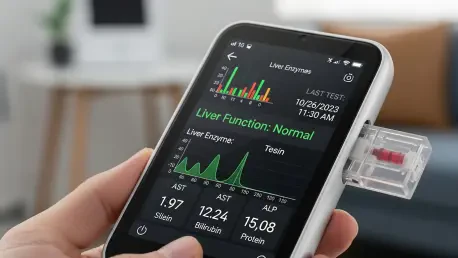
The shift from a multi-day waiting period to a sub-three-minute result is a monumental leap for both the patient and the clinician, especially when dealing with conditions like jaundice or acute liver distress. When a nurse in a remote primary health center can obtain a bilirubin reading almost instantly, the emotional weight of uncertainty is lifted from the patient immediately. Instead of the anxiety that builds while waiting for a distant lab to process a sample, a healthcare provider can make an informed decision on the spot, potentially starting life-saving treatments or arranging for urgent transport. This device essentially brings the power of a diagnostic lab into the palm of a hand, roughly twice the size of a smartphone, which is a game-changer for emergency diagnostics where every second counts. By bypassing the logistical nightmare of transporting blood samples across long distances, we are not just saving time; we are creating a more responsive and human-centric healthcare system.
Could you explain the technical significance of the nafion-chitosan membrane and gold nanoparticles in ensuring the sensor remains accurate?
Achieving high selectivity in a small, portable device is one of the most difficult hurdles in medical engineering, as human serum is a crowded environment filled with various proteins and acids. The nafion-chitosan membrane acts as a sophisticated biological gatekeeper, specifically attracting bilirubin molecules while physically and chemically rejecting “noise” from substances like uric acid and ascorbic acid. This is particularly difficult to get right at a physiological pH, but the research teams at BITS Pilani and Purdue have managed to create a layer that prevents these smaller molecules from corrupting the signal. The gold nanoparticles on the sensor surface further enhance the electrochemical reaction, ensuring that even a tiny serum sample yields a clear, readable result. Without this specific “surface chemistry,” the device would likely produce false positives or inaccurate readings that could lead to dangerous misdiagnoses in the field.
The device is designed for point-of-care use with a touchscreen and wireless data transmission. What does this mean for the daily operations of healthcare workers in remote or rural environments?
For a healthcare worker in a rural setting, the integration of an onboard touchscreen and wireless transmission means they no longer need to be a technology expert to perform sophisticated medical tests. The device is designed to be entirely self-contained, featuring its own power management system and signal-filtering electronics, which allows it to run on a rechargeable battery or a direct power supply. After the sensor processes the sample, the data is wirelessly beamed to a smartphone, creating a digital record that can be shared with specialists in distant cities for a secondary opinion. This creates a tactile, user-friendly experience where the focus remains on the patient rather than on troubleshooting a complex piece of equipment. The portability—being able to fit this diagnostic powerhouse into a pocket—means that a practitioner can move freely between homes or remote clinics without being tethered to a heavy station.
Since this prototype has reached Technology Readiness Level 4, what are the next critical steps to move from lab validation to widespread clinical availability?
Reaching Technology Readiness Level 4 is a major milestone because it proves that the concept works reliably in controlled laboratory conditions, showing strong agreement with standard clinical methods. However, the path to widespread deployment requires moving into rigorous clinical trials where the device must perform under the unpredictable conditions of real-world medical environments. We need to see how the sensor handles temperature fluctuations, varying humidity levels, and the diverse range of blood chemistries found in a broad patient population. There is also the logistical challenge of scaling the production of the disposable sensors coated with gold nanoparticles to ensure they remain affordable for low-resource settings. Once the reliability and repeatability are validated in a clinical setting, the focus will shift toward regulatory approvals, which will eventually allow this technology to move from the lab bench to the pharmacy shelf or the doctor’s bag.
The researchers suggested that this platform could be adapted for multiple disease biomarkers in the future. How do you see this modularity impacting the broader landscape of medical IoT?
The true genius of this platform isn’t just its ability to detect bilirubin; it is the inherent modularity of the electrochemical sensing mechanism. By making “suitable surface chemistry modifications,” the same core hardware could be adapted to detect markers for kidney function, cardiac distress, or even infectious diseases. This turns a single-purpose tool into a versatile diagnostic platform, which is exactly where medical IoT needs to go to be sustainable in developing regions. Imagine a single handheld device where a healthcare worker only needs to swap out a disposable sensor strip to pivot from testing liver function to checking for other critical health indicators. This would significantly lower the cost of entry for rural clinics, as they would only need to invest in one piece of hardware to gain access to a whole library of diagnostic capabilities.
What is your forecast for the future of decentralized liver health monitoring?
I believe we are entering an era where liver health monitoring will become as routine and accessible as checking one’s blood glucose levels at home. Within the next decade, the “deployment gap” mentioned by Professor Wu will narrow significantly as portable platforms like this one move through clinical trials and into the hands of the public. We will likely see these devices integrated into home-monitoring kits for patients with chronic conditions, allowing them to track their bilirubin levels daily and catch potential flare-ups before they become emergencies. Furthermore, the data collected by these IoT-enabled devices will provide a massive, anonymized dataset that could help researchers identify regional health trends and improve preventative care strategies. Ultimately, the future of liver health lies in empowering the patient and the local practitioner with immediate, lab-quality data, regardless of their proximity to a major metropolitan hospital.