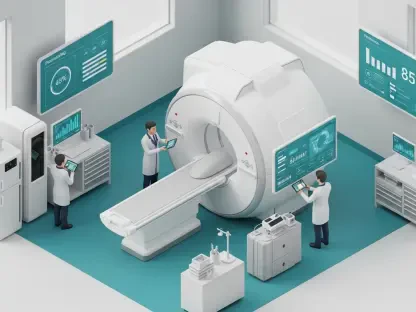

Hospitals are rapidly integrating a new class of technology capable of independent thought and action, transforming the healthcare industry into the ultimate proving ground for artificial intelligence. With the sector generating over 30% of the world’s data, AI is being woven into the fabric of diagnostics, scheduling, and documentation, promising unprecedented efficiency and improved patient outcomes. However, this revolution is happening at a pace that far outstrips the development of corresponding security and privacy protocols. The same intelligence that refines diagnostics also exponentially increases the number of entry points for malicious actors. According to a recent HIMSS survey, this has not gone unnoticed, as more than 72% of health leaders report high levels of concern regarding data privacy risks. Effectively securing this new environment requires a fundamental shift in how organizations interact with, manage, and ultimately, trust artificial intelligence.
The Double-Edged Sword of AI in Healthcare
The swift integration of AI into clinical and administrative workflows presents a paradox of immense potential and significant peril. More than 60% of healthcare professionals now value AI for its proficiency in identifying health patterns and suggesting potential diagnoses, and a striking 86% of organizations have already deployed AI in some capacity. This technology is no longer a futuristic concept but a present-day operational tool. The challenge arises because this deployment often outpaces the necessary security evolution. AI platforms, particularly the more advanced agentic models, do not conform to the traditional “one tool, one task” paradigm. Instead, a single AI system can serve numerous functions, interacting with and transferring data between multiple disconnected systems. This creates a complex, interwoven technological landscape where security vulnerabilities can be easily overlooked until a breach occurs, forcing a reactive rather than proactive security posture that leaves sensitive patient data exposed.
The Unique Dangers of Agentic AI
Agentic AI introduces a threat landscape fundamentally different from that of conventional software, primarily because these systems can make decisions and execute complex tasks autonomously on behalf of users. Unlike a simple program, an agentic AI can connect disparate tools across a health network, performing intricate operations automatically. The critical vulnerability lies in its ability to inherit permissions: anything a human user can access, the AI can also access, but it operates with machine speed and without fatigue or hesitation. This multiplies a healthcare system’s exposure to attack. Consequently, Chief Information Security Officers (CISOs) must evolve their strategies to treat agentic AI not as a tool but as an independent operator. This necessitates a framework of managed access, comprehensive action logging, mandatory encryption, and multi-factor authentication before the AI can interact with protected health information or critical system components. Without these robust guardrails, a compromised AI agent poses an exponentially greater risk than a compromised human user account.
The Escalation of AI-Powered Cyber Threats
For every innovative AI-based tool designed to modernize healthcare, CISOs must assume that cybercriminals are adopting and advancing the same technology for malicious purposes. Artificial intelligence is already the engine behind sophisticated phishing, ransomware, and data theft campaigns that are faster, more personalized, and significantly harder to detect. Attackers now leverage AI to synthesize stolen health data with insurance details and other personal information, crafting urgent and convincing messages that bypass traditional security filters by lacking the typical red flags of spelling and grammatical errors. Health records remain the most valuable asset on the dark web, containing a rich combination of clinical, financial, and personal identity information. In this environment, ransomware operations have also become more advanced, with AI helping criminals map networks, pinpoint high-value data, and deploy their malicious software automatically. A recent MIT Sloan survey revealed that up to 80% of new ransomware attacks are now enhanced or executed by AI, highlighting a clear reality: prevention alone is no longer a sufficient defense.
Building Trust with a Zero-Trust Approach
The legacy security frameworks underpinning most hospital systems were not designed to manage autonomous entities that possess the same privileges as human operators, making a “zero-trust” architecture the necessary default standard. This model operates on the principle that trust is never implicit; every request for access must be continuously and rigorously verified, regardless of its origin. Governance must transcend traditional firewalls and compliance checklists to actively manage how AI operates, what data it can access, and who holds accountability when failures occur. A key component of this strategy is network segmentation, which contains potential breaches by preventing them from propagating across the entire system. Furthermore, every vendor and third-party system must be thoroughly vetted before deployment, with explicit agreements on data ownership, prompt management, output control, and manual overrides. This level of scrutiny effectively disqualifies most “free” AI tools, which often carry the highest hidden cost: the exchange of institutional data and control for complimentary software.
An Action Plan for a Strong Defense
The relentless advancement of AI has reshaped the very foundations of healthcare and its security. It has become clear that resilience, not the sheer speed of adoption, marks true progress. Cybercriminals have moved faster than ever, using AI to automate and perfect their attacks, which has created a reality where the conversation has shifted from breach prevention to rapid recovery. Healthcare CISOs have recognized the opportunity to construct defenses capable of withstanding this new wave of threats. Their strategy centers on three core pillars: first, they audit all AI exposure to identify every system, dataset, and workflow connected to artificial intelligence. Second, they rebuild and fortify governance protocols to define ownership, access, and accountability for all AI operations before granting any system privileges. Finally, they reinforce their defenses, ensuring that zero-trust segmentation, multi-factor authentication, and immutable backups form the heart of their security plan. In the age of agentic AI, resilience depends not on how well hospitals use the technology but on how effectively they understand, contain, and govern its power.Fixed version:
Hospitals are rapidly integrating a new class of technology capable of independent thought and action, transforming the healthcare industry into the ultimate proving ground for artificial intelligence. With the sector generating over 30% of the world’s data, AI is being woven into the fabric of diagnostics, scheduling, and documentation, promising unprecedented efficiency and improved patient outcomes. However, this revolution is happening at a pace that far outstrips the development of corresponding security and privacy protocols. The same intelligence that refines diagnostics also exponentially increases the number of entry points for malicious actors. According to a recent HIMSS survey, this has not gone unnoticed, as more than 72% of health leaders report high levels of concern regarding data privacy risks. Effectively securing this new environment requires a fundamental shift in how organizations interact with, manage, and ultimately, trust artificial intelligence.
1. The Double-Edged Sword of AI in Healthcare
The swift integration of AI into clinical and administrative workflows presents a paradox of immense potential and significant peril. More than 60% of healthcare professionals now value AI for its proficiency in identifying health patterns and suggesting potential diagnoses, and a striking 86% of organizations have already deployed AI in some capacity. This technology is no longer a futuristic concept but a present-day operational tool. The challenge arises because this deployment often outpaces the necessary security evolution. AI platforms, particularly the more advanced agentic models, do not conform to the traditional “one tool, one task” paradigm. Instead, a single AI system can serve numerous functions, interacting with and transferring data between multiple disconnected systems. This creates a complex, interwoven technological landscape where security vulnerabilities can be easily overlooked until a breach occurs, forcing a reactive rather than proactive security posture that leaves sensitive patient data exposed.
2. The Unique Dangers of Agentic AI
Agentic AI introduces a threat landscape fundamentally different from that of conventional software, primarily because these systems can make decisions and execute complex tasks autonomously on behalf of users. Unlike a simple program, an agentic AI can connect disparate tools across a health network, performing intricate operations automatically. The critical vulnerability lies in its ability to inherit permissions: anything a human user can access, the AI can also access, but it operates with machine speed and without fatigue or hesitation. This multiplies a healthcare system’s exposure to attack. Consequently, Chief Information Security Officers (CISOs) must evolve their strategies to treat agentic AI not as a tool but as an independent operator. This necessitates a framework of managed access, comprehensive action logging, mandatory encryption, and multi-factor authentication before the AI can interact with protected health information or critical system components. Without these robust guardrails, a compromised AI agent poses an exponentially greater risk than a compromised human user account.
3. The Escalation of AI-Powered Cyber Threats
For every innovative AI-based tool designed to modernize healthcare, CISOs must assume that cybercriminals are adopting and advancing the same technology for malicious purposes. Artificial intelligence is already the engine behind sophisticated phishing, ransomware, and data theft campaigns that are faster, more personalized, and significantly harder to detect. Attackers now leverage AI to synthesize stolen health data with insurance details and other personal information, crafting urgent and convincing messages that bypass traditional security filters by lacking the typical red flags of spelling and grammatical errors. Health records remain the most valuable asset on the dark web, containing a rich combination of clinical, financial, and personal identity information. In this environment, ransomware operations have also become more advanced, with AI helping criminals map networks, pinpoint high-value data, and deploy their malicious software automatically. A recent MIT Sloan survey revealed that up to 80% of new ransomware attacks are now enhanced or executed by AI, highlighting a clear reality: prevention alone is no longer a sufficient defense.
4. Building Trust with a Zero-Trust Approach
The legacy security frameworks underpinning most hospital systems were not designed to manage autonomous entities that possess the same privileges as human operators, making a “zero-trust” architecture the necessary default standard. This model operates on the principle that trust is never implicit; every request for access must be continuously and rigorously verified, regardless of its origin. Governance must transcend traditional firewalls and compliance checklists to actively manage how AI operates, what data it can access, and who holds accountability when failures occur. A key component of this strategy is network segmentation, which contains potential breaches by preventing them from propagating across the entire system. Furthermore, every vendor and third-party system must be thoroughly vetted before deployment, with explicit agreements on data ownership, prompt management, output control, and manual overrides. This level of scrutiny effectively disqualifies most “free” AI tools, which often carry the highest hidden cost: the exchange of institutional data and control for complimentary software.
5. An Action Plan for a Strong Defense
The relentless advancement of AI has reshaped the very foundations of healthcare and its security. It has become clear that resilience, not the sheer speed of adoption, marks true progress. Cybercriminals have moved faster than ever, using AI to automate and perfect their attacks, which has created a reality where the conversation has shifted from breach prevention to rapid recovery. Healthcare CISOs have recognized the opportunity to construct defenses capable of withstanding this new wave of threats. Their strategy centers on three core pillars: first, they audit all AI exposure to identify every system, dataset, and workflow connected to artificial intelligence. Second, they rebuild and fortify governance protocols to define ownership, access, and accountability for all AI operations before granting any system privileges. Finally, they reinforce their defenses, ensuring that zero-trust segmentation, multi-factor authentication, and immutable backups form the heart of their security plan. In the age of agentic AI, resilience depends not on how well hospitals use the technology but on how effectively they understand, contain, and govern its power.