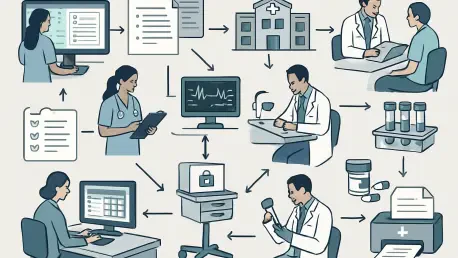

The relentless demand for comprehensive medical documentation has long tethered healthcare providers to their computer terminals, often at the expense of direct patient engagement and professional satisfaction. This systemic friction has prompted a shift toward sophisticated speech-to-cursor technologies that transform spoken words into structured data in real time. Commure Dictation represents a pivotal entry into this space, offering an AI-powered extension that functions directly within any desktop application or text field. By moving beyond the limitations of traditional transcription, the tool empowers clinicians to manage complex tasks like drafting detailed referrals, issuing clinical orders, and responding to patient messages using natural language commands. The system effectively bridges the gap between thought and documentation, allowing for a more fluid interaction with the electronic health record. This shift is not merely about speed; it is about reclaiming the clinical narrative from rigid interfaces.
Modernizing Infrastructure: Universal Compatibility and Integration
A major challenge with legacy dictation software has been the restrictive hardware requirements and cumbersome licensing models that stifle institutional agility. Commure addresses these pain points by enabling mobile devices to function as wireless microphones, effectively decentralizing the dictation process and allowing clinicians to work from virtually any location within the facility. This flexibility is complemented by a seamless migration feature designed to port existing macros and shortcuts from older platforms, ensuring that years of personalized workflow optimization are not lost during the transition. Furthermore, the extension operates across more than sixty different electronic health record systems, eliminating the need for providers to toggle between disparate software environments. Key features such as real-time text restructuring and automated template completion further refine the user experience. An integrated AI assistant provides on-the-fly support, helping to ensure that the generated notes are clinically accurate.
Strategic Convergence: Bridging Care and Revenue Operations
The current trajectory of healthcare technology suggests that documentation is no longer a standalone task but a foundational element of broader revenue cycle management strategies. Commure is positioning its dictation tool as a sophisticated data-gathering engine that feeds directly into coding and clinical documentation improvement workflows. By utilizing a unified data model, the platform ensures that the granular details captured during a patient encounter are immediately available to support financial accuracy and operational efficiency. This convergence reduces the administrative friction that typically occurs when back-office staff must retroactively clarify clinical notes to meet billing requirements. Looking ahead, healthcare organizations should prioritize the implementation of such integrated systems to harmonize clinical and administrative priorities. Moving to a model where documentation supports both patient care and institutional health became the standard approach. This transition allowed enterprises to focus on long-term sustainability.