
James Maitland stands at the forefront of a medical revolution, blending his deep expertise in robotics and the Internet of Things to redefine how we monitor human health. With a career dedicated to the seamless integration of technology and clinical care, he has observed the evolution of medical devices from bulky hospital equipment to the sleek, intelligent wearables we see today. His perspective is particularly vital now, as the healthcare landscape shifts toward personalized, real-time data collection. In our conversation, we explore the intricacies of the Delphi program, a bold initiative by the Advanced Research Projects Agency for Health to develop modular biosensors. We delve into the technical hurdles of chiplet technology, the regulatory complexities of the FDA’s new pilot programs, and the strategic importance of human-centered design in ensuring these high-tech tools actually improve patient lives at home.
The conversation covers the shift toward modular manufacturing in medical sensors and the regulatory risks associated with fast-tracking digital health devices for Medicare patients. We also discuss the impact of internal organizational changes at ARPA-H on the long-term viability of research projects and the rigorous three-phase roadmap required to move these innovations from the lab to the bedside.
New initiatives like the Delphi program utilize electronic “chiplet” technology to track biomarkers like inflammation and hormones. How does this modular approach change the manufacturing process compared to traditional sensors, and what are the specific technical challenges in integrating multiple disparate signals onto a single wearable platform?
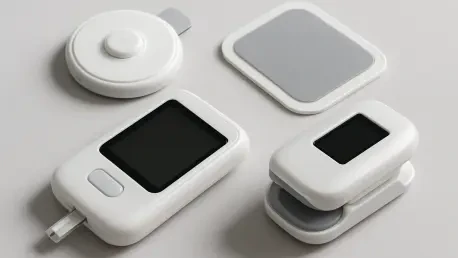
The shift toward a “chiplet” architecture is a fundamental departure from the rigid, monolithic manufacturing we’ve seen in medical devices for decades. By using what we call the “Lego block” approach, developers can keep core components stable while swapping out specific modules to track different biomarkers, such as hormones or drug levels, without redesigning the entire system. This modularity is a technical marvel but also a headache because each biomarker has its own chemical and electrical signature that must be isolated to prevent cross-talk. Imagine the precision required to house a sensor for inflammation right next to one for blood glucose while ensuring the electronic noise from one doesn’t drown out the faint signal of the other. Over the program’s four-and-a-half-year lifespan, engineers will have to navigate these complexities to ensure that “mixing and matching” components doesn’t degrade the accuracy that clinicians rely on for life-saving decisions.
The FDA is piloting a program to waive certain premarket requirements for digital health devices that collect real-world Medicare data. What risks does this pose for patient safety, and how should developers balance rapid data collection with the rigorous testing needed for clinical-grade wearables?
The vision shared by Health and Human Services Secretary Robert F. Kennedy Jr. to have all Americans utilize wearables is ambitious, but the FDA’s pilot program to waive certain requirements introduces a delicate tension between innovation and safety. When you allow devices to bypass traditional premarket hurdles to collect real-world Medicare data, you are essentially conducting a large-scale experiment on a vulnerable population. The primary risk is that a device might provide a false sense of security or, worse, inaccurate drug-level readings that lead to improper dosing at home. Developers must be incredibly disciplined, treating this pilot not as a shortcut, but as a period of hyper-vigilance where they are constantly auditing the data against clinical benchmarks. It’s a high-stakes balancing act where the emotional relief of a patient being home must never be overshadowed by the cold, hard necessity of technical reliability.
Given recent leadership shifts and the elimination of internal commercialization roles at ARPA-H, how can research teams ensure their multi-year projects actually reach the market? What specific milestones should be prioritized during the first two years to ensure these high-value investments yield scalable results?
The recent layoffs of commercialization staff and the shutdown of programs in AI and cybersecurity have certainly created a more pressurized environment for those of us in the research community. To survive, teams must be obsessed with hitting their phase-one milestones, specifically the creation of initial prototypes within the first two years. These prototypes aren’t just proofs of concept; they are the physical evidence needed to justify contracts that typically range from $30 million to as much as $150 million. Without a dedicated internal team to shepherd these breakthroughs to the private sector, researchers must bake commercial viability into their design from day one, focusing on manufacturing scalability. We have to prove that these biosensors are not just laboratory curiosities but are ready for the grueling demands of the real world and the complex regulatory applications that follow in the later phases.
A primary goal of multi-signal biosensors is to speed up hospital discharges by letting patients monitor drug levels at home. What human factors testing is necessary to ensure these devices are reliable for non-clinical users, and what metrics would define a successful transition from hospital to home?
Human factors testing is the bridge between a sophisticated piece of engineering and a tool that a grandmother can use in her living room without fear. We have to simulate the stress and cognitive load of a patient recently discharged from the hospital, ensuring that the sensor’s interface is intuitive and that the physical application of the device is foolproof. Success in this transition isn’t just about the device functioning; it’s defined by a measurable reduction in hospital readmission rates and a high degree of correlation between home-monitored drug levels and clinical lab results. There is a profound sensory relief when a patient realizes they can monitor their own inflammation markers from their sofa, but that peace of mind is entirely dependent on the device’s ability to communicate clearly and operate without constant technical intervention. We are looking for metrics like “time to intervention,” where a sensor alert allows a doctor to adjust a prescription remotely before a complication becomes a crisis.
The development roadmap for these sensors involves three distinct phases, ending in clinical trials and human factors testing. How do you anticipate these “mix and match” capabilities evolving as new biomarkers are added, and what hurdles exist in maintaining accuracy as more components are integrated?
As we progress through the three phases of the Delphi program, the “mix and match” capability will face its toughest test: the cumulative complexity of multi-signal integration. In the first two years, we focus on the basic prototype, but as we move into the integration phase, the hurdle becomes maintaining signal integrity across a broader array of biomarkers. Every time you add a new “chiplet” to the platform—perhaps moving from tracking hormones to monitoring specific drug concentrations—you introduce new variables that can affect the calibration of the existing sensors. The final phase, involving clinical trials, will be the ultimate judge of whether this modular evolution can maintain clinical-grade accuracy under the messy, unpredictable conditions of human biology. It is a rigorous journey where the engineering must be as flexible as the “Lego block” analogy suggests, yet as precise as the most advanced surgical instrument.
What is your forecast for biosensor technology?
I forecast that within the next decade, the “chiplet” model will move from experimental programs like Delphi to becoming the global standard for personalized medicine. We will see a shift where the “hospital at home” is no longer a futuristic concept but a daily reality for millions, powered by sensors that are as easy to wear as a decorative patch and as sophisticated as a modern diagnostic lab. However, this future depends entirely on our ability to navigate the current regulatory shifts and ensure that the multi-million dollar investments we are making today result in devices that are both accessible and unshakeably accurate. The ultimate success will be measured by the day we stop calling them “medical devices” and simply view them as an invisible, supportive layer of our everyday lives that keeps us healthy and out of the hospital.