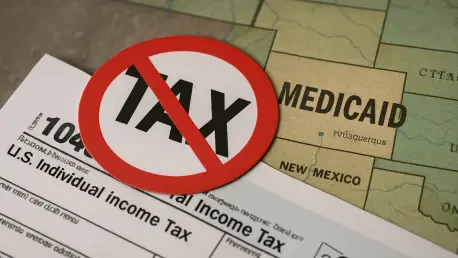

A new federal rule is set to fundamentally alter the intricate financial architecture supporting state Medicaid programs, introducing a period of profound uncertainty for lawmakers, healthcare providers, and the millions of Americans who rely on these services. The final rule, issued by the Centers for Medicare & Medicaid Services (CMS) in January 2025, implements a critical provision of the H.R. 1 budget reconciliation act that prohibits a specific type of provider tax states have long used to fund their share of Medicaid expenditures. This ban on certain “uniformity waiver” taxes threatens to dismantle a vital revenue stream, compelling states to navigate a complex and challenging new landscape where the stability of their healthcare safety nets hangs in the balance. The regulation’s rollout forces a nationwide reassessment of Medicaid financing, with potentially severe consequences for program sustainability and access to care.
The Foundation of Medicaid Financing Under Threat
At the heart of this issue lies a widely used fiscal tool known as provider taxes, which are assessments or fees levied by states on healthcare entities such as hospitals, nursing facilities, and managed care organizations (MCOs). The revenue collected from these taxes serves as a crucial component of the state’s contribution to its Medicaid program. By using this state-generated revenue, states can successfully draw down a larger share of matching funds from the federal government, effectively amplifying their ability to finance healthcare services for low-income populations. For decades, this mechanism has been an indispensable element of the federal-state partnership, enabling the support and expansion of Medicaid. To be permissible under federal law, these taxes must adhere to three fundamental requirements: they must be broad-based, they cannot include a “hold harmless” provision that guarantees taxpayers a return of their payments, and they must be uniform, meaning the tax rate is applied consistently to all providers within a designated class.
The flexibility in this system has historically come from a provision allowing states to seek a waiver from the uniformity requirement, provided they could demonstrate through a specific mathematical test that their non-uniform tax was “generally redistributive.” This has permitted states to design more nuanced tax structures that reflect the unique dynamics of their local healthcare markets. However, the new legislation, specifically section 71117 of H.R. 1, directly targets and invalidates a common strategy used to obtain these waivers. The law now explicitly prohibits any provider tax structured to impose lower rates on providers with minimal Medicaid-related revenue while levying higher rates on those with a substantial Medicaid patient load. Although this provision was primarily aimed at certain MCO taxes, its broad wording extends its impact to taxes on hospitals, nursing homes, and other provider types that have utilized this model, creating a ripple effect across the healthcare financing system.
Navigating the New Regulatory Landscape
The final rule issued in January 2025 provides the first concrete framework for how CMS will enforce this prohibition, offering much-needed clarity on timelines for compliance. Rather than imposing a single, abrupt deadline, the rule establishes a tiered system of transition periods that vary based on the type of provider and the recency of their waiver approval. For prohibited taxes on MCOs with waivers approved within the last two years, states are given until the end of 2026 to bring their systems into compliance. For MCOs operating under older waivers, this deadline is extended to the start of their 2028 fiscal year. The longest runway has been granted to all other affected providers, including hospitals and nursing facilities, which will have until the beginning of their 2029 fiscal year to adjust their financing mechanisms. This structured approach provides states with a more predictable, albeit challenging, path to adapt to the new legal reality, offering significantly longer transition periods for MCOs than was initially suggested in preliminary guidance.
In addition to setting timelines, the final rule updated the official assessment of which states are immediately impacted by the ban. While an earlier proposed rule had identified eight prohibited taxes across seven states, the final analysis confirms the existence of at least nine such taxes in those same states: California, Illinois, Massachusetts, Michigan, New York, Ohio, and West Virginia. Significantly, the newly identified tax applies to nursing homes, confirming that the rule’s impact extends beyond the initially targeted MCOs and hospitals. The preamble to the rule further suggests that the total number of non-compliant nursing home taxes may be even higher, highlighting that the full scope of the prohibition is still being uncovered by federal regulators. This expanding list underscores the complexity of state financing arrangements and suggests that more states may find their revenue structures under scrutiny as CMS continues its review and implementation of the law.
Unresolved Questions and Federal Discretion
Despite providing clear timelines, the final rule leaves one of the most pressing questions for states entirely unresolved, creating a significant legal and fiscal gray area. While section 71117 of H.R. 1 bans the specific uniformity waiver tax structure, a separate provision, section 71115, prohibits states from creating entirely new provider taxes or increasing existing ones to compensate for the lost revenue. The central ambiguity that remains is whether a state can simply modify its now-prohibited tax to make it compliant—for example, by making the rate uniform for all providers in a class—without that action being considered a “new or increased” tax under section 71115. The final rule fails to offer a definitive answer. While CMS noted it would provide technical assistance, it never explicitly stated that such modifications are exempt from the anti-supplementation provision. This lack of clarity creates enormous uncertainty for states attempting to find a viable path to compliance without running afoul of a different part of the same law.
The rule did, however, formalize a significant element of administrative flexibility by confirming that CMS will consider “legitimate public policy purposes” when it evaluates non-uniform tax structures. This means a state could potentially justify treating certain providers differently—for instance, by applying a different tax rate to rural hospitals, sole community providers, or psychiatric facilities—if it can demonstrate that the distinction serves a valid public goal, such as preserving access to essential care in underserved communities. While this offers a potential lifeline for some existing tax arrangements, it also vests considerable discretionary power in federal regulators. The rule provides no clear definition of what constitutes a “legitimate” purpose, giving CMS broad authority to approve or deny state financing plans on a case-by-case basis. This trend toward increased federal discretion creates a less predictable and more challenging environment for state Medicaid programs, which must now navigate not only a new law but also the subjective interpretations of the agency charged with enforcing it.
A Future Defined by Fiscal Uncertainty
The implementation of this rule marked a pivotal moment for state Medicaid financing, shifting the landscape from one of established practice to one of considerable ambiguity. States that had relied on these now-prohibited tax structures were left to confront a significant fiscal challenge with an unclear path forward. While the tiered transition periods provided a temporary reprieve, the fundamental questions surrounding tax modifications and the scope of federal discretion remained largely unanswered. The rule’s failure to definitively clarify whether states could amend their existing taxes to achieve compliance without violating other federal provisions left state policymakers in a precarious position. This created a complex environment where the search for sustainable, long-term funding solutions for Medicaid was fraught with legal and political hurdles, reshaping the dynamics of the federal-state healthcare partnership for years to come.