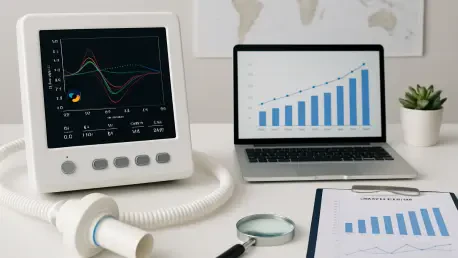

The global landscape of respiratory diagnostics is currently undergoing a monumental shift as healthcare systems move away from strenuous testing methods toward passive, non-invasive oscillometry technologies. Financial projections for this specialized sector indicate a steady and robust climb from a valuation of $168.30 million in 2024 to an estimated $242.66 million by the year 2031. This growth, representing a compound annual growth rate of approximately 5.5 percent, is not merely a numerical increase but a reflection of a systemic change in clinical priorities across the globe. As clinicians increasingly recognize the limitations of traditional spirometry in specific patient populations, oscillometry has emerged as a vital complement to existing pulmonary function tests. This evolution is driven by a collective demand for diagnostic accuracy that does not compromise patient comfort, particularly in complex cases where forced exhalation is physically impossible. The current trajectory suggests that these devices will soon become standard equipment in modern respiratory care.
Overcoming Physical Barriers: The Rise of Effort-Independent Diagnostics
One of the most significant advantages of oscillometry is its effort-independent nature, which effectively sets it apart from traditional spirometry and other lung function tests that require active participation. Because the technology measures lung mechanics during normal, tidal breathing, it eliminates the need for the intense and often exhausting forced respiratory maneuvers that many patients find difficult to perform correctly. This characteristic makes the technology indispensable for pediatric care, where children often lack the necessary coordination to follow complex breathing instructions, and for geriatric medicine, where elderly patients may face frailty or cognitive challenges. By removing the physical burden of testing, healthcare providers can obtain more reliable data from populations that were previously difficult to assess accurately. This transition toward passive measurement techniques is not just about convenience; it is about ensuring that no patient demographic is excluded from high-quality diagnostic monitoring.
Furthermore, oscillometry excels in detecting small airway dysfunction, a condition that is frequently missed by conventional testing until a respiratory disease has reached an advanced stage. By providing nuanced data on airway resistance and reactance at various frequencies, clinicians can identify subtle physiological changes much earlier than was possible with older methodologies. This capability is particularly vital in acute care settings, where patients in respiratory distress require diagnostic methods that do not add to their existing physical strain. The ability to pinpoint issues in the peripheral airways allows for more targeted therapeutic interventions, potentially slowing the progression of chronic conditions. As medical professionals shift their focus from reactive treatment to proactive management, the detailed insights provided by oscillometric resistance patterns are becoming a cornerstone of early intervention strategies. This proactive approach significantly reduces the likelihood of severe exacerbations and long-term lung damage.
Environmental Factors: Addressing the Global Respiratory Health Crisis
The primary catalyst for this market expansion is the increasing global burden of chronic respiratory conditions like asthma and chronic obstructive pulmonary disease which continue to rise. Factors such as rising atmospheric pollution, occupational hazards in industrial sectors, and persistent smoking habits continue to drive the demand for sophisticated and sensitive diagnostic tools. As these diseases become more prevalent in both urban and rural environments, the medical community is focusing on earlier detection and more frequent monitoring to improve long-term patient outcomes and manage public health costs. From 2026 to 2031, the focus will likely remain on bridging the gap between screening and treatment. This shift is essential because traditional diagnostic methods often fail to catch early-stage degradation in lung function, leading to delayed treatments that are both more expensive and less effective. The current focus is on building a resilient diagnostic infrastructure.
Public health management strategies are also evolving to include more comprehensive lung health assessments as a part of routine check-ups rather than reserved for symptomatic cases. This broader application of oscillometry helps in identifying at-risk individuals before they experience significant loss of quality of life, which is a major goal for healthcare administrators worldwide. By integrating these non-invasive tests into standard protocols, providers can track the longitudinal health of a patient with greater precision. The data generated from these frequent assessments allows for a more personalized approach to medicine, where treatments are adjusted based on real-time physiological feedback rather than generic symptoms. This shift is particularly important in regions where environmental toxins are a constant threat to respiratory health. Ultimately, the goal is to create a diagnostic environment where lung function is monitored as regularly and easily as blood pressure, leading to a significant reduction in the global burden of chronic respiratory disease.
Smart Engineering: The Convergence of Portability and Artificial Intelligence
The evolution of device design is a major secondary driver for the industry, specifically focusing on the principles of portability and the decentralization of specialized medical care. Modern oscillometry systems are moving away from the bulky, stationary laboratory equipment of the past toward streamlined handheld and benchtop devices that offer the same level of precision. This shift allows for high-precision diagnostics to be performed in outpatient clinics, rural health centers, and even at the hospital bedside, significantly expanding the reach of respiratory care. By bringing the technology to the patient rather than requiring the patient to travel to a specialized center, healthcare systems are improving access and reducing the time between the initial consultation and a definitive diagnosis. These portable solutions are particularly beneficial in underserved areas where specialized pulmonary laboratories are often non-existent or difficult for many residents to access.
Technological progress is also evident in the rapid development of hybrid devices and the deep integration of digital connectivity within the existing healthcare framework. Manufacturers are increasingly merging impulse oscillometry and forced oscillation techniques with traditional spirometry into a single, cohesive platform that provides a 360-degree view of lung health. These systems are now frequently equipped with cloud-based storage capabilities and full electronic health record compatibility, ensuring that data is accessible to any authorized specialist within a network. The integration of artificial intelligence is the next major frontier, offering predictive insights into potential patient flare-ups and assisting clinicians in interpreting complex resistance patterns that might be overlooked by the human eye. This digital transformation is turning raw physiological data into actionable clinical intelligence, allowing for a level of diagnostic accuracy and speed that was previously unattainable in standard respiratory medicine.
Geographic Expansion: Navigating Regional Growth and End-User Adoption
The end-user ecosystem for these diagnostic devices is becoming increasingly diverse, with large hospitals currently maintaining the largest share of the market due to high patient volumes. However, diagnostic laboratories and independent respiratory clinics are seeing rapid adoption as they specialize in providing comprehensive and high-precision lung function testing services. Additionally, academic institutions are utilizing these tools more frequently for advanced respiratory research and to evaluate the efficacy of new pharmacological treatments during complex clinical trials. This wide adoption across different sectors of the healthcare industry ensures a stable and growing demand for next-generation oscillometry equipment. As clinical guidelines continue to update and include oscillometry as a recommended practice, more facilities are expected to invest in these systems to remain competitive and provide the highest standard of care to their diverse patient populations.
On a geographic level, North America remains the clear market leader due to its advanced healthcare infrastructure and the early adoption of high-end medical technology across its networks. Europe follows closely behind with a strong emphasis on preventive medicine and well-established clinical guidelines that prioritize non-invasive testing for chronic disease management. Meanwhile, the Asia-Pacific region has been identified as the fastest-growing market, fueled by rapidly expanding healthcare systems in India and China and a massive pool of potential patients. Increasing governmental focus on managing chronic respiratory diseases in these emerging economies is driving significant investments in diagnostic infrastructure. This regional growth is supported by a rising middle class that is demanding better healthcare services and a more proactive approach to wellness. As these markets mature, the competition among global manufacturers is expected to intensify, leading to further innovations in both device affordability and ease of use.
Clinical Integration: Establishing New Standards for Pulmonary Assessment
To maximize the benefits of these technological advancements, healthcare organizations should prioritize the training of clinical staff on the interpretation of oscillometric resistance and reactance data. While the test itself is easy for the patient to perform, the wealth of information provided requires a sophisticated understanding of pulmonary mechanics to translate into effective treatment plans. Facilities that invest in comprehensive education programs will likely see the greatest improvements in patient outcomes, as their clinicians will be better equipped to catch early signs of disease. Furthermore, integrating oscillometry data directly into longitudinal patient tracking systems will allow for a more nuanced view of how chronic conditions evolve over time. This approach not only improves the accuracy of individual diagnoses but also contributes to a larger pool of data that can be used to refine treatment protocols for entire populations.
The industry successfully transitioned toward a more patient-centric model of respiratory care that prioritized accessibility and early detection through non-invasive means. Stakeholders across the medical spectrum recognized that the effort-independent nature of oscillometry solved a critical gap in diagnostic capabilities for the most vulnerable patient groups. By 2031, the widespread adoption of portable and AI-enhanced devices effectively decentralized pulmonary testing, moving it from specialized labs into primary care settings. Healthcare providers leveraged these advanced tools to identify small airway dysfunction years before it manifested as severe obstructive disease, allowing for more conservative and successful management strategies. This technological evolution ultimately reinforced the importance of physiological monitoring in maintaining long-term health. The global medical community moved toward a standard where lung function was treated with the same diagnostic rigor as other vital signs, ensuring a proactive future for respiratory wellness.