
The terrifying reality of catastrophic internal bleeding is that patients often succumb to their injuries before they can even reach the sterile environment of a modern operating room. In a landmark achievement for medical technology, Arsenal Medical has recently reported the first successful human application of ResQFoam, an experimental biomaterial device designed to manage severe abdominal hemorrhaging. This clinical milestone took place at the University of Alabama at Birmingham (UAB) under the REVIVE clinical trial, which operates with an Investigational Device Exemption from the FDA. Given its Breakthrough Device designation, the technology is being fast-tracked to address a critical gap in trauma care where traditional methods like manual pressure or tourniquets are physically impossible to apply. The successful stabilization of a critically injured patient marks a shift from theoretical laboratory success to a practical life-saving tool that could redefine emergency response protocols globally.
Mechanisms of Hemostasis: The Science of Internal Pressure
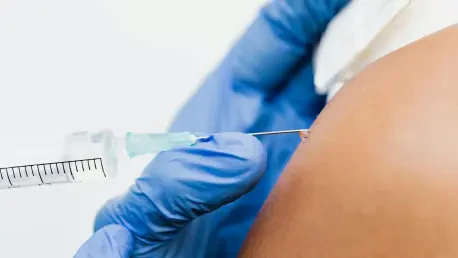
ResQFoam operates on a principle frequently compared to a “fix-a-flat” tire repair kit, though its biological application is far more sophisticated. The device consists of two liquid components that, when injected into the abdominal cavity, react to form a rapidly expanding polyurethane foam. This material is engineered to conform to the irregular geometry of the internal organs and the abdominal wall, exerting uniform pressure across the site of injury. This mechanical tamponade effect is crucial for controlling non-compressible hemorrhaging, which remains a leading cause of death in both traumatic accidents and combat scenarios. By filling the void and applying pressure directly to damaged blood vessels, the foam provides an immediate physical barrier against further blood loss. This intervention is specifically designed for use in the “golden hour” of trauma, where every minute saved significantly increases the statistical probability of a patient’s long-term survival.
Unlike permanent implants or systemic drugs, this biomaterial is intended to serve as a temporary bridge to definitive surgical repair rather than a final cure. Once the patient has been stabilized and transported to a surgical suite, the foam is designed for relatively easy manual removal by the trauma team. This allows surgeons to access the underlying vascular or organ damage and perform the necessary repairs without the interference of a permanent foreign body. The ability to remove the material cleanly is a critical feature, as it ensures that the emergency intervention does not complicate the subsequent recovery or lead to long-term inflammatory responses. Furthermore, the chemical composition of the foam is optimized to be biocompatible for the short duration it remains within the body. This balance between high-pressure efficacy and surgical compatibility represents a significant advancement over previous attempts at internal packing, which often caused secondary tissue damage.
Clinical Evidence: Validating the Paradigm Shift in Trauma
The clinical viability of this approach was recently demonstrated in a high-stakes emergency involving a 34-year-old victim of a high-speed motor vehicle accident. Upon arrival at the University of Alabama at Birmingham trauma center, the individual was in a state of profound hemorrhagic shock, exhibiting no detectable blood pressure and minimal signs of life. Standard resuscitation efforts were failing to stabilize the patient due to the severity of internal abdominal injuries. Following the rapid administration of the expandable foam, the medical team observed a significant and immediate improvement in the patient’s vital signs, including the return of measurable blood pressure. This stabilization provided the surgical team with the necessary window to move the patient into the operating room and perform the intricate procedures required to repair the trauma. This case serves as a powerful proof of concept, illustrating how a biomaterial can intervene in scenarios that were previously considered unsalvageable.
This human success story aligns closely with years of rigorous preclinical data that indicated the foam’s ability to achieve rapid hemostasis across a wide variety of lethal injury models. Before reaching the REVIVE trial, the material underwent extensive testing to ensure that its expansion was predictable and its pressure levels were sufficient to stop arterial bleeding without causing crush injuries to delicate internal organs. The transition from animal models to successful human application confirms that the physics of the foam’s expansion translates effectively to the larger and more complex human anatomy. Researchers noted that the patient not only survived the initial trauma and the subsequent surgical intervention but was also successfully discharged from the hospital to begin the recovery process. This outcome underscores the potential for ResQFoam to become a standard component of trauma kits in the near future, filling a massive void in current medical capabilities for managing massive internal bleeding.
Historical Context: From the Battlefield to the Civilian Emergency Room
The development of this technology was primarily driven by the urgent needs of the military, having received substantial funding from DARPA and the U.S. Army Medical Research and Development Command. On the battlefield, uncontrolled abdominal bleeding is recognized as the single largest cause of preventable death, often occurring in remote areas where immediate surgical intervention is unavailable. For decades, combat medics have sought a tool that could manage internal injuries with the same effectiveness that a tourniquet manages a limb injury. The collaboration between the Department of Defense and material scientists like Robert Langer and George Whitesides has focused on creating a solution that is portable, easy to administer under stress, and effective in extreme environments. By addressing the most challenging cases of non-compressible hemorrhage, the project has successfully moved through the various stages of development to finally reach the point of civilian clinical trials in 2026.
Transitioning this technology into civilian Level 1 trauma centers represents a logical progression in the evolution of emergency medicine. While the battlefield provided the initial impetus, the data suggests that civilian trauma, such as car accidents and industrial mishaps, presents similar challenges regarding internal hemorrhaging. Experts like Dr. Preston Hewgley and COL David King have emphasized that the survival rate for catastrophic abdominal injuries remains stubbornly near fifty percent, even in the most advanced medical facilities. This high mortality rate highlights the inadequacy of current standards of care, which often rely on aggressive fluid resuscitation that can sometimes exacerbate bleeding. The introduction of an expandable biomaterial represents a fundamental shift toward active mechanical control of the injury site before the patient ever reaches the operating table. This approach not only saves lives in the short term but also preserves organ function by preventing the prolonged periods of low blood flow associated with shock.
Future Considerations: Scaling the Implementation of Biomaterial Interventions
Arsenal Medical continues to lead the way in utilizing advanced materials to solve historically underserved medical problems, with the success of the REVIVE trial being a primary focus. As the study expands to more Level 1 trauma centers across the United States, the focus will remain on gathering comprehensive data to confirm the safety and long-term efficacy of the foam. The company’s leadership has noted that the validation provided by the first successful human case is only the beginning of a broader effort to standardize this intervention. Future iterations of the technology may include variations in foam density or expansion rates to suit different types of internal injuries, such as those occurring in the thoracic cavity or around major vascular junctions. The goal is to create a versatile platform that can be deployed rapidly by paramedics and emergency physicians alike, ensuring that the technology is available as close to the point of injury as possible to maximize the chances of survival.
The path forward for this technology involved the integration of specialized training programs for trauma surgeons and emergency responders to ensure precise administration. It was recognized that the successful deployment of ResQFoam required a clear understanding of abdominal anatomy and the specific triggers for its use. Medical institutions began evaluating how to incorporate this device into standard trauma protocols, shifting the focus from passive monitoring to proactive internal stabilization. The collaborative efforts between private industry and military research paved the way for a more resilient trauma care infrastructure. Ultimately, the transition to widespread clinical use depended on the continued success of the REVIVE trial and the ability of medical teams to replicate these early results across diverse patient populations. This evolution in care marked the end of an era where internal bleeding was often a death sentence and introduced a new standard where bioengineered solutions provided the critical time needed for life-saving surgery.