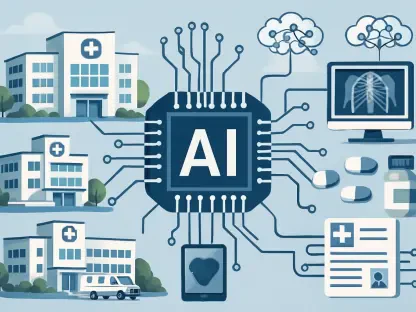

In an era where medical research faces mounting pressures to deliver faster and more affordable solutions, Artificial Intelligence (AI) emerges as a revolutionary force, particularly in the realm of cardiovascular clinical trials. The adjudication of clinical events, once a painstaking process reliant on human experts sifting through mountains of data, is being transformed by advanced technologies such as Large Language Models (LLMs) and Natural Language Processing (NLP). This shift promises not only to streamline drug development but also to redefine efficiency and accuracy in trials that are critical to addressing heart-related conditions, which remain a leading cause of global mortality. The implications of this technological breakthrough extend beyond mere automation, offering a glimpse into a future where life-saving therapies reach patients sooner, costs are slashed, and the reliability of trial outcomes is significantly enhanced. As AI reshapes this landscape, it’s clear that the healthcare industry stands on the brink of a paradigm shift, one that could alter the trajectory of medical innovation for years to come.
Unlocking Precision with AI Technology
The cornerstone of AI’s impact on cardiovascular clinical trials lies in its ability to handle complex, unstructured medical data with unprecedented precision. Unlike earlier automation tools that struggled with rudimentary algorithms and keyword matching, today’s AI systems leverage LLMs and NLP to interpret diverse sources like doctors’ notes, lab results, and imaging reports. This sophisticated approach involves a two-stage process: extracting pertinent information from raw data and then adjudicating clinical events based on established guidelines from clinical endpoint committees. Studies have demonstrated an impressive 87% concordance rate with human experts when identifying critical events such as heart failure hospitalizations, highlighting a level of accuracy that rivals traditional methods. This technological edge ensures that trial outcomes are not only faster but also more consistent, reducing the variability often seen in manual reviews.
Beyond raw accuracy, AI introduces innovative frameworks that bolster transparency and trust in its decision-making processes. Tools like the “Tree of Thoughts” reasoning model allow AI to navigate complex clinical scenarios with structured logic, mimicking human thought patterns in a way that’s comprehensible to researchers. Additionally, the development of metrics such as the CLEART score provides a standardized way to evaluate the clarity and reliability of AI-generated clinical reasoning. These advancements address a critical need for accountability in automated systems, ensuring that stakeholders can understand and validate the AI’s conclusions. As a result, the integration of such technology is setting a new benchmark for how cardiovascular trials are conducted, paving the way for broader acceptance across the medical research community.
Slashing Costs and Accelerating Timelines
One of the most immediate and tangible benefits of AI in cardiovascular clinical trials is the dramatic reduction in both financial and temporal costs. Drug development has long been a resource-intensive endeavor, with pharmaceutical companies pouring billions annually into research and development, a significant portion of which goes toward labor-intensive adjudication processes. By automating these tasks, AI eliminates the need for extensive manual review, cutting down on expenses tied to human expertise and administrative overhead. This cost-saving potential is transformative, allowing companies to allocate resources more strategically while maintaining the rigor of their trials. The financial relief provided by AI could ultimately democratize innovation, enabling smaller firms to compete in a space historically dominated by industry giants.
Equally significant is the acceleration of trial timelines that AI facilitates, which carries profound implications for patient care. Faster adjudication means that clinical trials can conclude more swiftly, shaving months or even years off the journey from lab to market for new therapies. This speed is particularly crucial in the context of cardiovascular diseases, where timely access to innovative treatments can mean the difference between life and death for countless individuals. Moreover, shorter trial durations extend the patent-protected period for new drugs, enhancing profitability for developers and incentivizing further investment in research. The ripple effect of this efficiency is felt across the healthcare ecosystem, promising a future where critical treatments are not delayed by procedural bottlenecks.
Redefining Industry Dynamics and Competition
The adoption of AI in cardiovascular trials is reshaping the competitive landscape for a wide array of stakeholders within the pharmaceutical and technology sectors. Major players like Pfizer and Novartis stand to gain immensely from reduced research and development costs, as well as the ability to bring drugs to market more rapidly, securing a stronger foothold in a fiercely competitive industry. Contract Research Organizations (CROs) such as IQVIA are also positioned to enhance their service offerings by integrating AI-driven adjudication tools, thereby attracting more clients seeking cutting-edge solutions. This shift underscores how AI is not merely an operational tool but a strategic asset that can redefine market positioning for those who embrace it.
On the other hand, the rise of AI poses challenges for traditional manual adjudication providers, who risk obsolescence if they fail to adapt to this technological wave. Meanwhile, tech giants like Google and Microsoft are seizing the opportunity to develop and license powerful AI platforms tailored for clinical trials, leveraging their extensive expertise in data processing and machine learning. At the same time, startups specializing in healthcare AI are finding fertile ground to innovate, either by carving out niche applications or becoming acquisition targets for larger corporations. This dynamic illustrates a broader trend of technological disruption, where the ability to harness AI becomes a key differentiator, separating industry leaders from those left behind in an evolving market.
Expanding Horizons for Healthcare Innovation
AI’s transformative role in cardiovascular clinical trials extends far beyond immediate operational gains, signaling a broader potential to revolutionize healthcare research as a whole. By standardizing the adjudication process, AI enhances the quality and reliability of trial data, ensuring that conclusions about treatment safety and efficacy are grounded in consistent, high-quality evidence. This improvement is vital for regulatory submissions and clinical decision-making, as it minimizes errors that could compromise patient outcomes. Furthermore, AI enables the execution of larger, pragmatic trials that reflect real-world conditions, providing deeper insights into how therapies perform across diverse populations and settings, ultimately leading to more effective healthcare solutions.
However, this promising trajectory is not without significant challenges that must be navigated carefully. Regulatory bodies are still grappling with how to validate AI-driven decisions, requiring the development of clear guidelines to ensure compliance and safety. Concerns about data bias in AI training sets also loom large, as skewed inputs could lead to flawed adjudications that disproportionately affect certain patient groups. Ethical questions surrounding the delegation of critical medical judgments to machines add another layer of complexity, necessitating robust frameworks for accountability. Addressing these hurdles is essential to maintain trust in AI systems and to ensure that their integration into clinical trials prioritizes patient welfare above all else, fostering a balanced approach to innovation.
Charting the Path Forward for AI in Trials
Reflecting on the strides made in cardiovascular clinical trials, it’s evident that AI has already begun to redefine the boundaries of medical research with remarkable success. The automation of adjudication processes through LLMs and NLP marked a pivotal moment, achieving high accuracy and consistency that matched human expertise in many instances. This technological leap reduced the burden of manual labor, allowing trials to conclude more swiftly and at lower costs, which in turn benefited pharmaceutical companies and patients alike. The competitive shifts within the industry, as stakeholders adapted to AI’s potential, underscored the transformative power of this innovation during its early adoption phases.
Looking ahead, the next steps involve a concerted effort to expand AI’s application beyond cardiovascular research into other therapeutic areas like oncology and neurology, while refining its capabilities for even greater precision. Integrating AI with electronic health records and clinical trial management systems could enable real-time monitoring, further enhancing trial efficiency. Establishing universal regulatory standards and addressing ethical concerns around data privacy and bias remain critical priorities to ensure safe and equitable implementation. As the industry moves forward, fostering collaboration between tech developers, healthcare providers, and regulators will be key to unlocking AI’s full potential, ensuring that past achievements pave the way for a future where clinical research is faster, more reliable, and universally accessible.